by
For as long as I have worked in this industry, we have treated an empty space as a demand problem. The kiosk on the busiest floor sits idle, and we assume the market is soft, the mix is wrong, and the timing is off. I want to argue something different. The space is rarely empty because nobody wants it. It is empty because nobody could find it, price it, and book it fast enough to matter. That is not a demand problem. It is an information problem. And information problems are precisely the kind of thing that disappears when intelligence enters the system.

Travel retail is where this becomes impossible to ignore. A transit hub has the one thing every brand on earth is fighting for: a real audience in motion, measurable by the hour. The dwell time is real. The footfall is real. The intent is real. And yet a meaningful share of the most valuable square meters in that building spend the year half-used, because the machinery to sell short-term space has always lagged a decade behind the machinery to sell everything else. We can buy media programmatically in milliseconds. We can price an airline seat differently every hour of the day.But to put a brand in a pop-up for four days, we still send a PDF and wait. That gap is about to close, and it will not close gently.
The First Move Has Already Happened
And it is quieter than the revolution that follows it. The online marketplace turned the back-and-forth of specialty leasing into something a brand can do itself. A brand opens a platform, sees every space available across an asset, checks the audience numbers, picks a date, books it, and uploads the creative without a single phone call. Mall of Tripla, one of the largest shopping and mobility hubs in the Nordics, runs this today across four floors, including a Travel Hub floor sitting above a railway station that moves tens of millions of people a year. The platform behind it is HyperIn. That marketplace matters less for what it does and more for what it makes possible. Once every space, every price, and every booking live in one connected system, the space stops being a static asset on a floor plan. It becomes data. And from this moment, intelligence can act on it. This is the part the industry has not fully reckoned with yet.
Here is Where it Goes
I am not hypothetical about the direction, just about the date: The space starts selling itself.
Not as a metaphor. An intelligent layer reads which brands are searching, which categories convert in which zones, which weeks run hot and which run cold, and it goes out to find the tenant the space deserves. The empty unit on floor four stops waiting to be discovered and starts marketing itself to the brands most likely to want it, in their language, at the price the data supports, around the clock. Pricing moves the way it moves in aviation and hospitality, higher when demand is dense, lower to fill a quiet Tuesday, never frozen on a rate card written last spring.
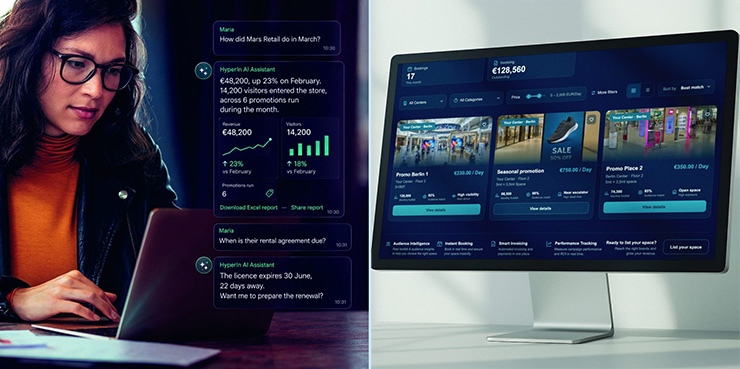
Then the reports write themselves. Every asset manager opens the day to a live picture of their commercial inventory: occupancy by zone, revenue per square meter, conversion by brand category, which licenses expire in the next 45 days, and which spaces are drifting toward idle before anyone notices. No analyst is pulling numbers. No month-end scramble. The asset tells you how it is performing and what to do next, like a trading desk watching a market.
The wildest part, and the one I am most convinced about, is the concierge. I do not mean a chatbot bolted onto a website. I mean a single intelligence living inside the platform and marketplace, working every side of the building at once. For the visitor, it drives footfall by turning idle online curiosity into a reason to show up, answering questions and steering people toward what is happening in the building right now, with a level of service that feels almost unsettlingly personal. For tenants, managers, and partners, it becomes the one place to find anything—a contract clause, a document, a help article, an answer buried three folders deep — surfaced in seconds. For specialty leasing, it guides a brand through a booking, answers questions about audience and pricing in real time, closes the deal, and delivers the performance report. One intelligence serving every stakeholder in the way that matters to them.
This is the Shift I Want the Industry to See Coming.
The asset stops being a landlord that holds space and becomes something closer to a media company that sells attention, with the building itself as the inventory and intelligence as the sales force that never sleeps. Markus Porvari, President and CEO of HyperIn, puts it more plainly: “We are heading toward a world where every space in a property knows its own value, its own audience, and its own performance, and acts on it.
Specialty leasing is where this happens first, because it moves fast enough to prove the model. At HyperIn, we are that world. The success of our customers is the only thing we measure, and we deliver it with the smartest combination of technology and commercial real estate expertise. The assets that get there will not manage inventory. Their inventory will manage itself.”
Travel retail will lead this, not follow it. A shopping street learns slowly. A transit hub learns every single day, because the audience refreshes every single day. Every condition that makes intelligent commercial management work is already sitting in these buildings, waiting for the software to catch up to the opportunity. It is catching up now. And the empty space that we spent a generation blaming on the market is about to vanish, not because demand changed, but because the space finally got smart enough to sell itself.

Jean Carlos Delgado
Jean is responsible for driving the overall HyperIn’s strategic marketing and brand direction, based on his 15+ years of experience working with global brands and innovative teams.
Contact:
Twitter: twitter.com/jeancadelgado
Linkedin: linkedin.com/in/jeancarlosdelgado
HyperIn: https://www.hyperin.com