ACROSS: Mr. Kolev, you have been CEO of Trinity Capital AD in Bulgaria for more than seven years. How has the market changed during that time?

Stoyan Kolev: Seven years ago, Bulgaria was still a relatively underpenetrated retail market compared with the larger CEE markets. What has changed is not simply the amount of retail space, but the maturity of the market itself.
We have seen an expansion of modern retail outside Sofia, particularly through the rapid development of retail parks. Retailers have become much more confident about expanding into regional cities and smaller catchment areas, while consumers have become more discerning about their expectations. Convenience and value remain fundamental, but accessibility, tenant mix, food, leisure and the overall experience are increasingly important.
It is no longer enough to build retail space in a good location and expect demand to follow. Successful assets need a clear proposition, strong tenants and a deep understanding of their catchment.
Bulgaria has therefore moved from being a market with significant untapped potential to one that is evolving. There is still room for growth, but the opportunity is about quality, differentiation and execution rather than simply adding more space.
Bulgaria joined the eurozone in January 2026 and continues to rank among the EU’s faster-growing economies. Is the country entering a new phase of retail real estate development?
Yes, although I would describe it as a phase of market evolution rather than simply acceleration. The adoption of the euro is an important milestone. Although the lev had been pegged to the euro for many years, Bulgaria‘s entry into the eurozone further integrates the country into the European economic and financial system and makes the market more straightforward for international businesses and investors to assess and operate in.
The underlying alignment with European economies is also important. Bulgaria‘s real GDP grew by 3.1% in 2025, while the European Commission forecasts 2.5% growth in 2026. GDP per capita has also continued to progress toward the EU average, reaching 68% of the EU level in 2025, compared with 38.4% in 2006.
“The question is no longer whether there is an opportunity, but whether you have the expertise to identify the right opportunity.“
For retail real estate, this is creating a different environment. We are moving beyond the question of whether there is enough demand for modern retail and asking which formats, locations and concepts will capture that demand most effectively. Retail parks have been a major driver, but we are also seeing greater diversification formats and more sophisticated expectations from both retailers and consumers.
So yes, I believe we are entering a new phase. Continued economic growth, eurozone membership and a more mature and segmented retail sector are coming together. For investors, that creates a market that is more integrated with Europe, easier to understand and still offers meaningful room for growth.
Consumer spending is growing, but European consumers remain increasingly value-conscious. How is the Bulgarian consumer changing?
I think the Bulgarian consumer is becoming more sophisticated about value, rather than more price-sensitive.
There is certainly a strong focus on affordability. But value today is a much broader concept than price alone. Consumers are asking themselves: What am I getting for my money? Is the product worth it? Is shopping convenient? Can I trust the brand? Is the experience itself worth my time?
This is particularly relevant in Bulgaria because household incomes and consumption have been growing, but consumers remain selective about where they allocate their spending.
For retailers, competing on price is therefore not enough. The proposition is more about delivering clear and credible value through the right price, the right product, convenience and a compelling customer experience.
We also see this in the evolution of retail formats. Retail parks respond well to consumers‘ need for convenience and efficient shopping. Outlet retail addresses the desire for branded products at attractive prices.
Shopping centers, when well positioned and managed, can offer something different: a broader combination of retail, food, leisure and social experiences. I would describe the Bulgarian consumer today as value-conscious, but not driven by price alone. That distinction matters.
If you had to convince a Western European retailer or investor to take a closer look at Bulgaria, what would be your strongest argument?
Bulgaria still offers something that is becoming difficult to find in more mature European markets: meaningful room for growth. It remains an underpenetrated market in many segments where consumer purchasing power continues to converge with the rest of Europe. At the same time, the market is becoming more integrated with the European economy, particularly following euro adoption. For a retailer, there is an opportunity to establish a strong position before the market becomes fully saturated. For an investor, the attraction is the combination of income-generating assets, economic convergence and the potential for further evolution and consolidation.
“Retail is not one market. It is a collection of consumer missions, catchments and formats.”
And what would be the biggest caveat?
Bulgaria is a relatively small market, and the investment market is not as deep or liquid as Poland, Germany or even Romania. You cannot simply take a successful concept from another European market, replicate it here and assume it will work.
In fact, Bulgaria has reached a point where the easy opportunities are disappearing. Retail supply is growing rapidly, and competition for the best locations and tenants is increasing. The question is no longer whether there is an opportunity in Bulgaria, but whether you have the expertise to identify the right opportunity.
For us, that is precisely where local knowledge matters. Understanding the catchment, consumer behavior, retailer requirements and the competitive landscape is what turns an attractive market into a successful investment.
Retail parks have become the dominant growth story in Bulgarian retail real estate. Why has the format resonated so strongly with both retailers and consumers?
Retail parks respond very directly to the way consumers want to shop today, while also offering retailers an efficient platform for expansion.
For consumers, the fundamental proposition is convenience: easy access, ample parking, straightforward navigation and the ability to combine several different shopping missions in one visit. In a market where people are conscious of both their money and their time, that matters. For retailers, the equation is equally compelling. Retail parks can provide highly visible locations, efficient store formats and attractive occupancy economics, while allowing brands to expand beyond the largest urban centers.
This has been important in Bulgaria because there is a significant regional market beyond Sofia that still has room for modern retail concepts.
Does the success of retail parks come at the expense of shopping centers?
I don‘t think so. It would be too simplistic to view the success of retail parks simply as a consequence of consumers moving away from shopping centers. The formats serve different purposes. A retail park is strong when the consumer wants accessibility, convenience and efficiency. A shopping center can be stronger when the consumer is looking for a broader experience.
What we are seeing in Bulgaria is not just the growth of a particular retail format. It is the emergence of a more diversified retail landscape, where different formats specialize in meeting different consumer needs. And that is why I believe the strongest retail parks will continue to evolve. The next generation will not be defined only by parking and convenience. They will need to give consumers a reason to stay longer, return more often and see the destination as part of everyday life.
Trinity Capital has begun to evolve its retail parks from convenience-driven schemes into destinations that integrate food, leisure and social functions. Is this mixed-use idea likely to spread across retail assets?
I believe the destination concept will become even more important, but I would not say that every retail asset should become mixed-use in the same way. The key question is not how many leisure or food components you can add to a retail concept. It is whether you are creating a more relevant destination for the people who live around it.
Consumer behavior is becoming more fluid. A shopping trip can now include a meal, a coffee, a service, entertainment or time with family and friends. Retail, food and leisure are part of the same consumer journey. The assets that recognize this will naturally generate more reasons to visit and more opportunities to increase frequency and dwell time.
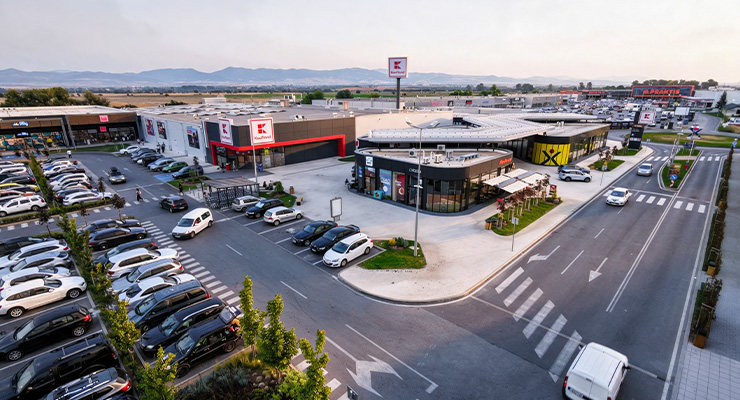
For us, this is particularly relevant as we develop the next generation of XOParks. We see the retail park evolving from a place where consumers come to buy something into a place where they can accomplish several things in one visit and spend some time there.
But I would strongly resist applying a standard mixed-use formula everywhere. A retail park serving a regional city has different needs from a shopping center in central Sofia, and a convenience-led format should not be burdened with unnecessary functions simply because “experience” is fashionable.
The future is therefore not about making every retail asset look the same. It is about making each asset more relevant to its catchment.
Bulgaria‘s leading shopping centers continue to achieve exceptionally high occupancy rates. What separates the malls that thrive from those that struggle?
I don‘t think success or failure can be explained by the format itself. The strongest malls continue to perform well because they offer something that is difficult to replicate elsewhere.
For me, the starting point is the catchment. A shopping center needs sufficient purchasing power and population density. It also needs a clear proposition and a tenant mix that gives people a reason to visit regularly. Accessibility, parking, food and beverage, entertainment and services all play an important role.
The best-performing centers have also understood that they are competing for consumers‘ time, not only for their spending. If a shopping center can combine retail with food, leisure, social interaction and services in a way that feels natural, it becomes more resilient.
At the other end of the spectrum, centers tend to struggle when they lack a clear identity, have an undifferentiated tenant mix or are located in a catchment that cannot support the scale of the asset.
In those cases, adding more retail space or simply changing a few tenants does not solve the underlying problem.
The market will reward assets that understand their role and execute it well. The strongest projects will be defined by their relevance to the consumer and the strength of the catchment they serve.
Bulgaria is about to get its first professional outlet village. What does that tell about how the Bulgarian retail market is evolving?
I see the emergence of authentic outlet retail as another sign that the Bulgarian retail market is becoming more mature and more segmented.
The Bulgarian consumer is already familiar with outlet shopping. Many people have experienced outlet villages elsewhere in Europe, and the concept is well established through international travel and online shopping. What has been missing is a professionally developed outlet destination in the domestic market, with the right scale, brand mix and positioning.
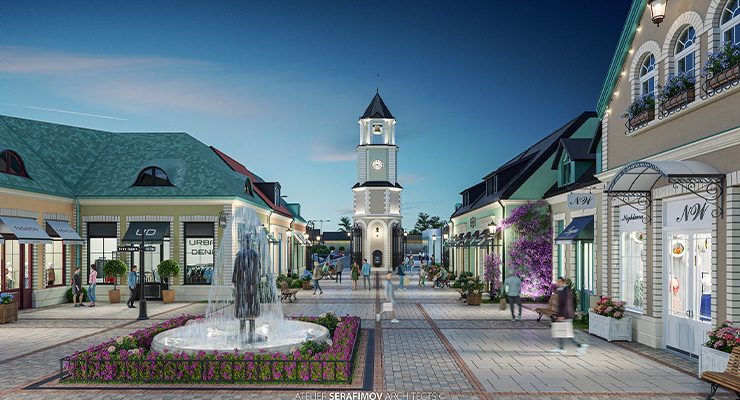
The interesting point is that consumers are becoming more sophisticated about how they shop for value. An outlet proposition combines recognized international brands with attractive pricing, in a destination where shopping experience itself becomes part of the proposition.
It also reflects a maturation on the retailer side. A professional outlet sector requires brands to think more strategically about distribution, inventory and how they address different consumer segments without weakening their core full-price business.
This is another indication that Bulgaria is moving toward a more diversified retail ecosystem. We now have strong shopping centers, a rapidly expanding retail park sector, growing convenience retail and, with the arrival of the outlet village, another distinct format addressing a different consumer need. A mature retail market is not one where everyone builds the same type of property. It is one where different formats can coexist because they serve different consumer missions.
Your portfolio now amonG DIFFERENT asset classes. Where do you see the greatest growth opportunities?
I don‘t think the biggest opportunity is necessarily in one particular property type. I see the greatest potential in identifying the right format for the right catchment.
There is still considerable room for the expansion of modern retail outside Sofia. Regional cities and underserved catchments can support significantly better retail propositions than they have historically had, provided that the format is appropriate to the market. This is one of the reasons we have been so focused on regional locations with the XOParks.
So is the next phase more about improving existing assets than simply building new ones?
The next stage of the market will not be about adding square meters. It will be about increasing the quality, relevance and productivity of the space that already exists through better tenant mixes, stronger food and leisure components, improved services and a clearer proposition to the consumer.
There are also opportunities in specialized formats such as outlet and convenience retail. These are interesting precisely because they address very specific consumer needs rather than trying to be everything to everyone.
If I had to identify one overarching opportunity, it would be the continued development of modern retail beyond Sofia into underserved regions. There are still markets where modern retail concepts can make a meaningful difference to consumers and retailers, but the approach has to be much more selective than five or ten years ago.
Ultimately, retail is not one market. It is a collection of consumer missions, catchments and formats, and the opportunity lies in matching those three correctly.
What do you believe will be the defining trend in Bulgarian retail real estate over the next decade?
If I had to identify one defining trend, it would be the professionalization of the market, by which I mean a shift from simply developing retail space to creating assets that are genuinely productive, relevant and resilient over the long term.
The period when retail development could be driven by adding square meters is coming to an end. There will be more competition, consumers will have more choice, and retailers will become even more selective about where they invest. As a result, the quality of the asset, the strength of its catchment, the relevance of its proposition and the quality of its management will matter more than ever.
I also believe we will see a continued blurring of the traditional boundaries between retail, food, leisure, services and community. But I don‘t think every asset needs to become an entertainment destination. The strongest assets will be those that understand what their particular consumers need and build the right proposition around that.
For Bulgaria specifically, I see the next decade as a transition from narrowing the gap to competing. We have spent many years catching up with more developed European economies. As purchasing power continues to grow and the market becomes integrated with Europe, the question will be which investors, retailers and assets can compete successfully in a much more sophisticated market.
Ultimately, I think that is the defining trend: retail real estate will become less about owning space and more about understanding people. The assets that succeed will be the ones that know their consumers, understand their catchments and continuously earn the right to be visited.
This article was originally published in ACROSS 4/2026.