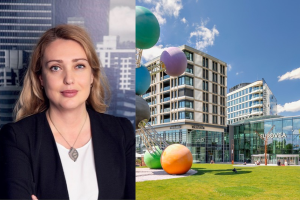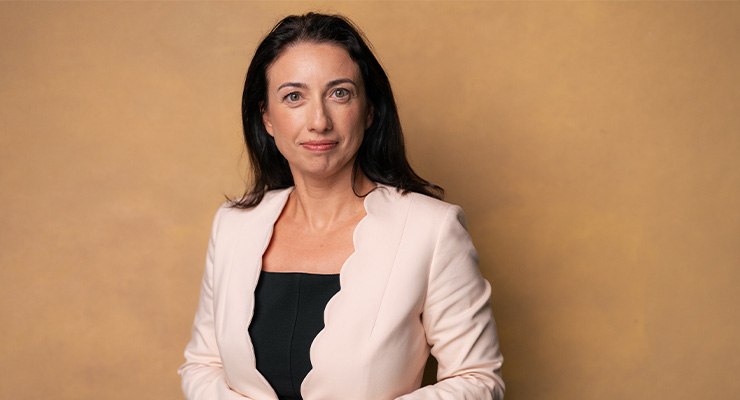
NEPI Rockcastle‘s first investment outside Central and Eastern Europe marks a new chapter for the company. Chief Investment Officer Anca Nacu explains where and why she sees future opportunities.

ACROSS: NEPI Rockcastle has built a large retail real estate portfolio over the years. What are the key investment principles behind that expansion?
ANCA NACU: I have been working on expansion at NEPI Rockcastle for 12 years, and the key principles have remained largely the same. We start with the fundamentals of the region, the city and, of course, the asset. We need a good catchment, growing cities and good demographics. At the asset level, location, size and the underlying fundamentals are essential.
We also look for value enhancement opportunities. We have a strong asset management team, and we do not buy assets simply as a bond or a coupon. We buy assets to work with them. From the early stages, we therefore need to identify our long-term plan for an asset. It is not sufficient to buy a property. We also need to see scope to improve it and create additional value.
“It is not sufficient to buy a property. We also need to see scope to improve it and create additional value.”
For example, with acquisitions such as Forum Gdańsk, Magnolia Park and Silesia City Center, we achieved a valuation uplift of around €200 million on acquisitions totaling slightly more than €1 billion. That illustrates why value enhancement is an important part of our strategy. Ultimately, we have to deliver additional value for our shareholders, beyond simply building a large and attractive portfolio.
These factors do not always come together. How do you weigh them against each other?
It is always a trade-off. Ideally, we would have a dominant asset, a rich catchment and a perspective to enhance the property. But you cannot always have everything. We also look at the portfolio as a whole. You need strong, dominant assets where you can leverage your position with tenants, but you also need assets with a sharper growth path where you can unlock more value.
There are also clear non-negotiables. If the catchment is not right or the asset fundamentals are wrong, we will not pursue an investment, even if there are other reasons to do so. We are looking at the long term: what will happen to this city and this asset in five or ten years? If the answer is not satisfactory, we walk away. But prudent growth is essential.
Over the past years, NEPI Rockcastle has remained considerably more active than many of its peers. Why?
We come from a somewhat more entrepreneurial background. We started as a relatively small company and followed a very fast growth trajectory. That helped us retain the spirit we started with, as well as the drive to identify new investments. In CEE, competition is not as fierce as in some other markets, and we are now the dominant player in the region. Over the past 10 to 15 years, we have built a strong network, which makes it easier to identify what we want and act quickly when the right asset comes along.
“Retail destinations need attractiveness for the community. They cannot simply be convenience centers.”
Another important factor is our balance sheet. We have always been prudent in maintaining financial firepower. That allowed us to seize opportunities after COVID when others were perhaps not in the same position. Keeping that flexibility has been an important part of our ability to act.
Your first investment outside CEE is MegaPark Barakaldo in Spain. What made this particular asset stand out?
For our current size, CEE has become a relatively small investment universe. And because we are very selective about acquisitions, assets that meet our criteria do not come up frequently.
We therefore started looking at Western Europe some time ago. Spain was a logical choice because of its macroeconomic fundamentals and growth compared with other Western European markets. It also has many similarities with CEE, including the tenant base. Many of the brands we already work with are present in Spain, which creates potential synergies between the two platforms.
We started with a top-down approach: Which region makes sense based on its fundamentals? We then looked at which assets in that market would fit our strategy. MegaPark Barakaldo is very much the type of asset we prefer. It is a large, dominant scheme serving Bilbao, a strong and affluent city in northern Spain. It is also part of a much larger retail destination. And we know many of the tenants, too. That familiarity, combined with the scale and dominance of the asset, made it a good fit with our existing portfolio.
So, the move to Spain is the beginning of a broader expansion beyond CEE?
Definitely. This is just the first step. When we enter a market, we want to build a relevant presence and unlock synergies. So now, our focus is in Spain, potentially looking at Iberia as a somewhat larger area. But we will continue to look for suitable opportunities in CEE and invest when they meet our criteria. There, the risk-return profile is also becoming more balanced. Yields may still differ between markets, but in Poland, for example, the major cities have already caught up with Western Europe. The gap is no longer what it used to be. Ultimately, we assess each investment individually, including the financing costs, and look at the bottom line. Spain is within our risk profile and our cost of capital.
Where do you currently see the most attractive opportunities across markets?
Spain and Iberia offer a significantly larger market, with more cities, shopping centers, liquidity and room for investment. But there are still very interesting opportunities in CEE, and they differ by country. Poland and the Czech Republic are more active in terms of M&A, while Romania offers attractive development opportunities.
“We are real believers that retail real estate will continue to outperform.”
Historically, we always combined acquisitions and developments. As the CEE market has become more saturated over the past 10 to 15 years, it is more difficult to find development options for large, dominant shopping centers. But there are still significant value-creation opportunities.
Our Promenada project in Bucharest is a good example. We are developing a major extension with retail, hotel and office components in the heart of the city. Projects like that are increasingly scarce in Western Europe.
So, while Spain has opened a new door for us, we continue to work extensively in our home market where there is still significant potential to create value. But as the market becomes more saturated, we are doing more refurbishments, extensions and improvements. We are reshaping assets such as Bonarka in Poland, where we have been working for many years, as well as Arena in Budapest and Arena Center in Zagreb. This will become increasingly important for the resilience of shopping centers. You have to continuously change and improve them. The days when you could simply provide a box for merchandise and expect customers to come are gone. You have to reinvent the destination continuously.
Green energy has also become an additional component of our strategy. We are deploying photovoltaic panels across the portfolio and developing greenfield energy projects in Romania. The objective is to increasingly supply our own shopping centers and tenants with renewable energy. This can create attractive returns while also supporting our sustainability objectives.
How does the rise of multifunctional destinations affect your investment approach?
We are developing mixed-use projects, but we are not necessarily looking to acquire them. Office and hotel assets tend to offer relatively flat year-on-year returns, whereas retail gives us more opportunities to work with an asset, improve it, extend it and extract additional value. When we include offices, hotels or entertainment in a development, they are there to enhance the retail destination. They are not the objective in themselves. We prefer to focus, rather than spread ourselves across too many directions. But we do not exclude mixed-use when it makes sense.
What will distinguish successful retail investments of the future?
Size matters. We are seeing a shift towards large and dominant schemes. Smaller convenience centers, including retail parks, will have their place. But medium-sized shopping centers can be difficult to make resilient because they are too small to allow you enough flexibility to transform the asset and change the tenant mix. Larger centers give you more flexibility to adapt as customer preferences change. You can improve the center, bring in new tenants with new requirements and introduce fresh brands.
Of course, the fundamentals remain essential and risks are everywhere. But the ability to work with the asset, adapt it and continuously change the concept is equally important. If you do not invest in the asset, it can become obsolete. We also see entertainment becoming more important. Retail destinations need attractiveness for the community. They cannot simply be convenience centers.
“We are real believers that retail real estate will continue to outperform.”
You have to remain alert but keep a cool head and be ready to react and seize opportunities. When the war in Ukraine started, many people said we should leave CEE. We decided to remain calm and the market subsequently opened up many new possibilities for us. You need to understand the surrounding environment, including interest rates and the broader economic situation. This is why we maintain a very prudent approach and a strong balance sheet.
Finally, what would be your main argument to invest in retail real estate today?
People are social animals. They are hungry for experiences and for getting together. As long as you create places where people can gather and build communities, retail real estate remains successful. And, if managed correctly, it can create significant value for shareholders. We are real believers that retail real estate will continue to outperform.