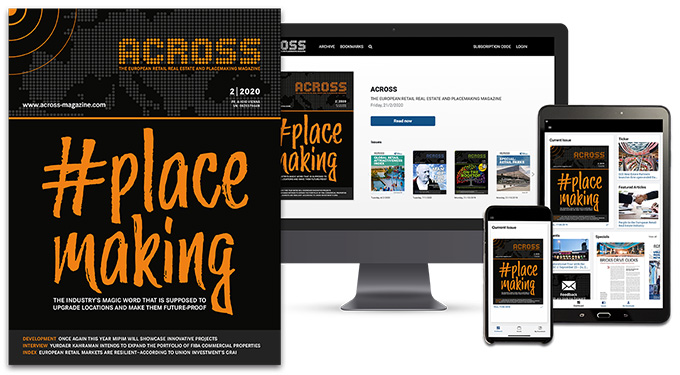
For decades, the fundamental question in retail real estate was where to build. Location, location, location. Today, another question is becoming increasingly important: Who are you building for, and how can you create value from the people who visit? At MAPIC, ACROSS spoke with the Generatik Product Manager and creator of The Mall Effect Index, about the untapped potential of shopping center advertising, the growing importance of audience data, and why physical retail spaces could become much more sophisticated media environments.

Beyond the Traditional Advertising Model
ACROSS: You have been working in shopping center advertising for quite some time. What made you rethink the business model?
Răzvan Marincoi: Generatik was launched in 2025, building on the experience of its parent company, Brand Management, which has been active in indoor advertising in Central and Eastern Europe for more than 20 years. When we looked at the market, we identified a fundamental gap. Shopping centers already manage advertising spaces, but most do so within their own portfolios and networks. External brands and media agencies, however, often struggle to access these spaces in a consistent and efficient way.
Imagine a brand wanting to run a campaign across five shopping centers in the same city, each owned by a different company. The brand must contact five operators, negotiate five different rate cards, understand five sets of specifications, and coordinate five separate booking processes. It is time-consuming, and quite often the campaign ends up being reduced to the two or three locations that are easiest to access.
The problem is that brands do not plan their campaigns by landlord. They plan by city, audience, and target group.
So, shopping centers are potentially missing out on advertising revenue simply because the market is too fragmented?
Exactly. Most shopping centers already have an advertising portfolio. They have digital screens, columns, banners, escalators, atriums, and various other spaces. But a substantial part of this inventory is allocated to tenants, often as part of leasing agreements or promotional support. That makes sense because tenants are the shopping center’s primary stakeholders.
However, external brands represent another source of revenue. Cosmetics, pharmaceutical companies, banks, and telecommunications brands, for example, already advertise in shopping centers. The challenge is making these spaces easier to access for a much broader range of advertisers.
We see shopping centers as venues with different stages. The central atrium is one stage, perhaps the most prominent one. A food court is another, with a different audience and atmosphere. A children’s area is a family-oriented stage. Even the parking area can be an interesting advertising environment, particularly for mobility brands.
The question is how to match the right message with the right audience and the right location.
“A shopping center’s audience is its own database.”
For decades, the real estate industry has focused on location as the decisive factor. Are you suggesting that the audience is becoming just as important?
For 30 years, the most important question in real estate was where to build. Location, location, location. But an additional question is now becoming increasingly relevant: Who do you build that location for?
A shopping center’s audience is its own database. Every visitor represents an opportunity to communicate with someone. Think about a newsletter. If you have 37,000 subscribers, you know the size of your audience. You can measure opening rates, reading rates, and clicks.
Now ask a shopping center owner how much a pair of eyes entering the building is worth. Many operators still struggle to give you a clear answer. They sell advertising spaces according to established rate cards, market practices, or their own assessment of what a particular location should cost. But advertisers increasingly want to understand the audience behind those spaces.
Footfall figures are useful, but they are only the beginning. We need to understand who is visiting, how people behave, what attracts their attention, and how advertising influences their decisions.
How can shopping center operators develop this understanding?
We have been conducting research in Romania for four years. This led us to develop what we call the Mall Effect Index. It combines four weighted dimensions: conversion (40%), advertising recall (30%), purchase intent (20%), and visit frequency (10%).
We wanted to move beyond isolated snapshots and create a way to compare results over time. The research allows us to understand how visitors respond to advertising in shopping centers and how that response translates into consumer behavior.
Our findings are interesting. Around eight in ten visitors remember advertising they have seen in a shopping center, and more than six in ten say they have purchased something after seeing an advertisement there.
Of course, declared behavior is not the same as independently verified purchasing data. Nevertheless, these findings indicate that physical advertising deserves considerably more attention from brands and property owners.
We are also moving towards more granular assessments of individual locations and advertising spaces. This will help advertisers compare different opportunities rather than simply choosing a location because it happens to have high footfall.
“The industry does not necessarily need more data. It needs more actionable data.”
You also distinguish between different audience groups rather than relying exclusively on traditional demographic categories.
Yes. Age and gender alone do not tell you enough. We have developed audience categories that combine demographic characteristics with behavioral and lifestyle-related assumptions.
For example, we identify groups such as the Amplifiers, combining female and Generation Z audiences, who can have a cultural influence beyond their actual numbers. Another group is the Power Nurturers, combining female and millennial audiences, who often make purchasing decisions for the family and research products carefully.
The purpose is to give advertisers a more meaningful understanding of whom they are trying to reach.
Does this also change the way we should think about the relationship between physical shopping and digital channels?
Absolutely. We still encounter retailers who think of their physical store as the place where the actual sale takes place, while digital is something separate. But the shopping ecosystem is both physical and digital.
Our research shows that people visit shopping centers to see products, interact with them, and consider purchasing them. Sometimes they complete the transaction in the store. Sometimes they order online afterwards. But the customer journey does not necessarily end when someone leaves the shopping center.
We should not be afraid of digital. We should embrace it.
“Shopping is an emotional experience. The physical environment plays a major role in that journey.”
I can imagine a different retail model emerging from this. A store could become more of a showroom, where customers can experience and try products, while the retailer reduces its physical inventory and delivers the product to the customer’s home.
Exactly. Imagine trying on a jacket in a store. You like it, but the color you want is not available. Instead of having to visit another store or leave without buying anything, the salesperson can arrange delivery of the preferred version to your home.
The physical store becomes a place for interaction, advice, and experience. You can reduce the need for storage space and use digital technology to show additional options.
But I would add something important: shopping is also an emotional experience. People remember where they bought something, how the store smelled, what music was playing, and what the occasion was. The moment of purchase can become a memory.
Retailers should not underestimate that. You can be creative about the experience and the way you thank customers for shopping with you. The product does not necessarily have to leave the store with the customer.
And shopping center advertising can play a role much earlier in this journey, even before a customer has decided to buy something.
Yes. When you are scrolling through Instagram or TikTok, you are often looking for entertainment. When you enter a shopping center, you usually have a different mindset. You have made an effort to go there, and you probably intend to visit several stores.
That creates different opportunities for communication. An advertisement can introduce a product, trigger an interest, or encourage someone to start a conversation with a brand.
Think about a person waiting in a seating area while their partner is shopping. This is a very different situation from someone scrolling through social media. A relevant message can catch their attention and potentially trigger an interest in something they had not previously considered.
Not every purchase happens immediately. Someone might see a product, research it later on YouTube, visit the brand’s social media channels, and eventually make a decision. Shopping is psychological and personal. Brands need to understand that journey.
The important thing is relevance. You cannot play a jazz concert on a pop stage. Shopping centers need to understand their different environments and what kind of communication works in each of them.
“Technology only creates value when it translates into better business decisions.”
Artificial intelligence is another major topic in the industry. Where do you see its practical applications for physical retail environments?
I think we talk too much about the abstraction of AI and too little about what it can actually do for physical spaces.
There are several dimensions. Computer vision, for example, can anonymously monitor areas and provide heat maps showing how people move through a shopping center. You can understand dwell times, visitor flows, and interactions between different areas or stores.
Then there is predictive AI and generative AI. All these technologies have different applications, but we need to understand what we actually want to achieve with them.
AI depends on algorithms and the quality of the data we provide. If you feed it poor data, you will get poor results. From my perspective, the industry does not necessarily need more data. It needs more actionable data: information that helps people make better business decisions.
When we developed the Mall Effect Index, our first question was not what we could measure. It was which business decisions we could improve through the insights we generated.
But technology adoption in real estate can be challenging. Many operators already have numerous systems and platforms to deal with.
That is a very important point. There are many good people in real estate doing very good work. But when it comes to technology, providers sometimes approach the industry from the wrong direction.
They talk about algorithms, machine learning, and technical capabilities. The people on the property side, however, are thinking about costs, additional workload, and potentially losing control.
Technology companies need to translate their solutions into the language of real estate. Instead of explaining how an algorithm works, tell an operator that their property is performing better than last month, explain why, and show what they can do to improve it further.
You don’t need to sell technology to people who don’t feel they need technology. You need to demonstrate how it makes their work easier.
Is that also the thinking behind Generatik’s approach to integrating the different advertising inventories?
Yes. We want to make the process as straightforward as possible. A brand should be able to select locations, compare advertising opportunities, and book physical and digital spaces through one marketplace.
For shopping center operators, the marketplace connects to their existing systems through an API. They retain control of their advertising inventory, pricing, and approvals. We do not take over their advertising assets. We integrate them into a broader marketplace.
We also provide the operational support required to execute campaigns, including artwork, production, installation, and documentation. This is important because advertising in a shopping center is not simply a matter of booking a digital screen. Physical installations require coordination with the property, approved suppliers, and the relevant technical teams.
The idea is to make the process easier for both sides.
“Location still matters. But perhaps it is time to add another question: Who walks through that location, and who wants to reach them?”
You started in Romania. What are your plans for international expansion?
Poland and Spain are our next natural markets. They are both interesting retail real estate markets, but they also have something in common with Romania in terms of shopping behavior and the adoption of technology.
Poland is somewhat ahead of Romania in its development, while Spain and the Iberian Peninsula are particularly interesting because of their creativity in retail. We believe these markets offer good opportunities to test and develop our model.
However, we want to take things step by step. Our intention is to work with one flagship operator in each country initially. We need to understand how the market works, establish relationships with agencies and local suppliers, and develop a convincing case study before expanding further.
Is the long-term ambition to go beyond shopping centers?
Definitely. We started with shopping centers because they have large audiences and an established advertising infrastructure. But the same logic applies to office buildings, retail parks, mixed-use developments, cinemas, airports, and mobility hubs.
Consider airports. There are already established players doing excellent work in airport advertising. But if a brand wants to run a campaign across several airports, it still needs to deal with different operators, platforms, prices, and contracts.
We see a similar fragmentation in other physical environments. There are many advertising opportunities, but no single point where a brand can easily compare them and plan a campaign across multiple locations.
Imagine being able to search for escalator advertising targeting Generation Z for a fashion brand across Europe and receive a comparable selection of locations and opportunities.
That is the direction in which we believe the market can develop.
What was your main takeaway from this year’s MAPIC? Are property owners becoming more receptive to the idea of generating additional income beyond rent?
That was certainly one of the strongest themes I heard in Cannes. The industry is increasingly looking for income streams beyond traditional rental income.
Two weeks before MAPIC, I opened a retail panel in Bucharest by challenging a statement our industry rarely questions: location is everything.
Location still matters. But perhaps it is time to add another question: Who walks through that location, and who wants to reach them? For me, the audience is becoming the new currency of physical spaces.
FACT BOX
Generatik: By the Numbers
- 2025 Generatik was launched, building on the experience of its parent company, Brand Management.
- 20+ years Of experience in indoor advertising across Central and Eastern Europe through Brand Management, Generatik’s parent company.
- 125 brands worked with by Generatik in 2026.
- More than 200 campaigns delivered by Generatik in 2026.
- Four dimensions Generatik’s Mall Effect Index combines conversion (40%), advertising recall (30%), purchase intent (20%), and visit frequency (10%).
- Around 8 in 10 visitors remember advertising they have seen in a shopping center.
- More than 6 in 10 visitors say they have purchased something after seeing an advertisement in a
shopping center. - 10 shopping centers, 2 cities The scope of a campaign for an international dermatology brand in Romania.
- Almost 12 million visits Recorded across the shopping centers during the campaign period.
- Approximately €5 CPM The estimated cost per thousand contacts for the campaign.
Figures and research findings provided by Generatik