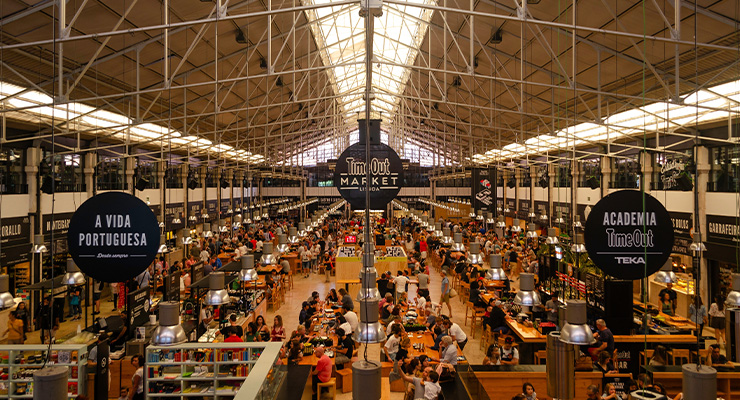
Too many developers have mistaken a roomful of food counters for a destination. Too many operators have mistaken a busy Saturday for a viable week. In way too many cases, there is a lack of alignment between the two parties, leading to this “F&B marriage” failing, divorce, and in many cases costly court action. Spectacular, headline grabbing and very readable but really sad and damaging the food and beverage industry.

So, what‘s the problem with the “hottest” F&B concept? I will try and unravel a bit of this on these pages.
This month I celebrated 50 years in the foodservice industry, starting at 14 years old washing bottles in glasses in a pub in Nottingham. I have seen a lot, so let me share what I think is right and wrong with market halls. Over the decade from 2016 to 2026, the contemporary market hall spread through warehouses, shopping centres and former stations. Its promise was seductive: independent kitchens, shared seating, central bars and the freedom for groups to eat differently together. Unlike traditional produce markets, these are principally foodservice businesses. Their real product is shared leisure time. In many cases, especially in warmer countries, traditional “produce” markets were morphed into massive “eating and drinking” markets.
In my mind the big daddy, TimeOut Lisbon is the classic leader, with massive turnover, a location that redefined the city and food tourism and a concept that has tried to be replicated around the world. All good so far…
The question is whether that shared leisure time generates enough money for everyone involved. I have spent over 35 years advising on F&B in the property industry and famously said very early on, that “our guest has two currencies, time and money”. Food courts were all about convenience, fast, choice, low costs sharing, but in almost every case they were low down on the “experience index”. Functional feeding troughs for the masses that made a lot of money for a lot of people and sadly generated tonnes of packing waste.
Along with Westfield and others I have worked to create a more elevated experience that uses real crockery, real cooking and metal cutlery, better interiors and more serious gastro. At that point I coined the phrase “a restaurant experience at a food court price” because that was the ambition and, in many cases, it came true and is still with us today.
“Variety without hospitality is simply a canteen with better branding.”
So back to market halls. Let’s have a look at the six trends that for me explain why some market halls thrive while others exhaust their traders, investors and customers.
Property ambition has outrun hospitality reality
The most revealing early casualty was The Hall at Lakeside, Essex, operated by Market Halls. It closed in January 2020, after less than six months, before pandemic restrictions could be blamed. Reporting described some traders taking as little as £10 daily. Transplanting fashionable London food brands into a shopping centre evidently did not transplant their audience. They have gone on to success elsewhere, but nobody really understood the DNA and needs of a business like this.
Yet the brand survived and resumed expansion. A failed site and a failed operator are different things, and I really enjoy what they are doing today, with ambition, quality and good times baked into their proposition.
My contention is that food halls too often become property solutions before anyone establishes a credible customer proposition. Empty retail space does not automatically contain unmet dining demand. A landlord’s need for activation is not a diner’s reason to visit.
You only need to see the attempt in Hamburg to give new life to the old Movenpick restaurant space in the classic Hanseviertel arcade. There is no better location in Hamburg in my view, but two TAM TAM failed attempts show a massive lack of understanding about the need for a “daylight” door, an entrance on the street and an immediate gastro experience, not walking past closed retail to get to your night out.
Yes, you can ignore these basics but please don’t expect success. Some of the best operators in Germany failed there.
The cost structure is becoming unforgiving
Market halls and food halls have opened and closed, like any commercial business. They are not immune. Vienna provides an even sharper warning. Gleis//Garten, opened in 2023 with food stalls, bars, events and an onsite brewery, saw its operating company enter insolvency in September 2026.
There are reported €4.5 million in liabilities and no intended continuation or restructuring, citing weaker purchasing power and rising rents and costs. So sad as the Kraft brewery onsite was state of the art and I have had the pleasure of knowing the family and interviewing them on my CEO talks.
These cases expose the danger of expensive communal space. Extraction, refrigeration, heating, cleaning, security and toilets require funding whether tables are occupied or empty. Historic architecture may attract customers; it can also impose brutal running costs.
Go back to my comment about successful market halls in warmer climates – In April 2026, the Mercado de San Miguel in Madrid was valued at €200 million in a massive transition of ownership. The Dutch Brenninkmeijer family (owners of C&A) acquired control of the market from the joint venture Redevco Iberian Ventures, which had originally bought it for roughly €70 million in 2017, that’s impressive as an asset, but underlying that is the “daily business” the volumes of guests and the gargantuan throughput.
Market Halls are designed to do big business, but, as always, size is important.
Manifesto at The Playce in Berlin has closed the first floor, reducing to half the square metres and relocating the successful traders from upstairs. Time will tell if that was the right more.
Entertainment is becoming core infrastructure
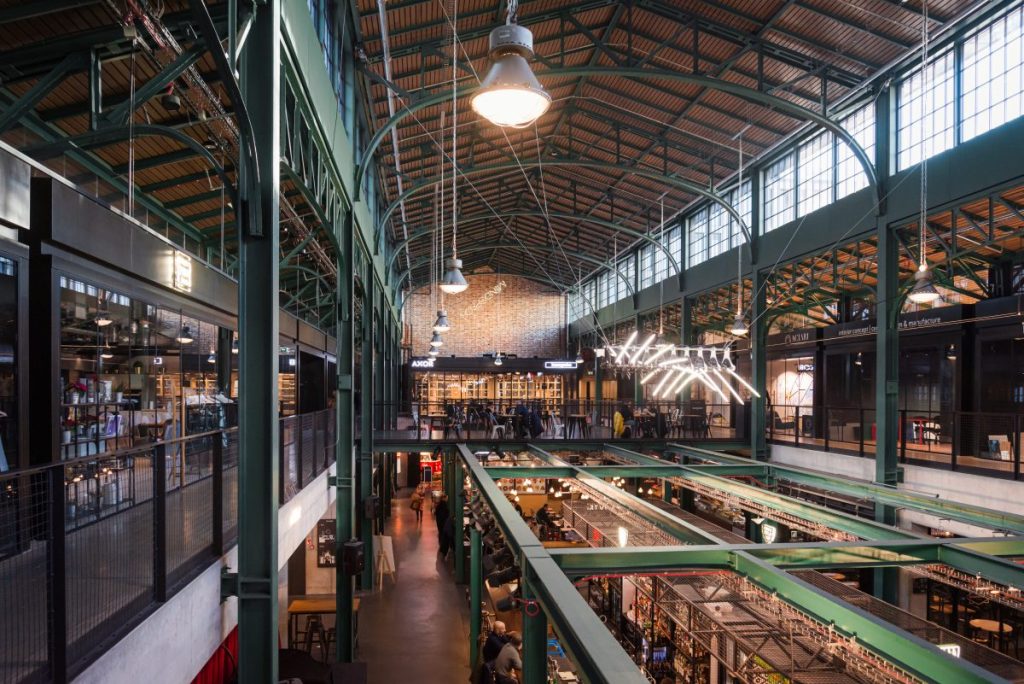
Warsaw understood something that many British imitators missed: people need reasons to return beyond another choice of lunch. Food courts “do” food, market halls “do” fun.
Hala Koszyki, relaunched in 2016, cultivated concerts, exhibitions, workshops and performances. Food Town at Fabryka Norblina combines culinary concepts and bars with a performance space, Gimlet Live Hall, concerts, stand-up and events.
To this day I say that if you want to see the best of gastronomy in retail, go to Warsaw. Poland is leading right now.
Food Town reported nearly three million visitors, over one million food bills and 351 music events in 2024. These are operator figures, not audited proof of profitability, but they demonstrate the intensity of the proposition.
I have had the pleasure of working with the Motz family who own Norblin and the foodservice proposition, and their understanding of entertainment as key ingredient is impressive. Real venues, real places to go, real fun and yes, you can get great food and drink as well. These are NOT just more expensive food courts with cooler designs; they are places where you want to spend your valuable time. Two currencies, one choice. The lesson is programming from inception: stages, acoustics, technical equipment, event sales and a calendar. Public performances build habit; private bookings monetise occasion. A DJ beside the toilets is not an entertainment strategy.
A recent visit to Stockholm saw me in Westfields Mall of Scandinavia, a project I worked on originally, enjoying a banging bowl of Chinese food whilst watching an up-and-coming local band. No cost, no ticket, and I nearly stayed too long, spending $24 in 35 minutes. That’s a restaurant spend…
The bar business and the kitchen business must align
Many halls place independent food traders alongside centrally operated bars. This can work brilliantly: shared facilities reduce entry barriers and groups generate several purchases within one visit. The hall operator runs those bars, takes the revenue and excludes their tenants from selling competitive drinks. This is not always the case but our relationship with alcohol is at the heart of this. It also creates a potential conflict. The hall operator benefits from drinks and dwell time; the kitchen needs sufficient food transactions to cover ingredients, staff and occupation charges. A crowded room does not always mean food sales for vendors.
The serious operator measures trader sales, retention, margins and repeat visits alongside bar revenue. Turnover rent is no miracle if service charges and commissions make the total burden unworkable. Nor is endlessly replacing exhausted vendors evidence of successful incubation.
My test is simple: can a competent trader pay staff properly, reinvest and earn a living here? If the answer is no, the hall is consuming independent businesses as decoration. This is not just sad, but reputationally damaging for the market hall AND the property in which it sits. The recent high-profile insolvency filing at Kalle Halle in Berlin saw the landlord take the market hall back and reorganise the operations after financial disputes.
“Not just food courts. But places where you want to spend your valuable time.”
Local identity and operational discipline beat generic variety
Manchester’s Mackie Mayor, the city I went to college in, operating since 2017, offers a durable example of independent food within a distinctive historic setting. Edinburgh’s Bonnie & Wild emphasises Scottish producers and culinary talent; Edinburgh Street Food adds a regular events programme, Saluhall in Malmo is such a gorgeous place to go to sit, laugh, enjoy and eat great food. It serves the local area beautifully and is owned by some very special people who understand what good looks like. Commercial success through engaged, emotional curation. A great example for me is KERB at 7 Dials. For so many years a “retail” destination, but once Simon and team took it, it became a “place” not a “space”. Epic commercial success and a lovely stimulating place to be.
There is a theme going on here. Good halls curate complementary cuisines, credible prices and different occasions. They provide clean tables, comfortable seating, clear ordering and coordinated service. Competitive socialising can add bookable revenue, but darts or games must justify their floor area.
Expansion increasingly means exporting a system
Time Out Market remains the clearest global brand: its Lisbon pioneer predates this decade, while subsequent growth has reached Europe, North America, Africa, Asia and the Middle East. Osaka opened in 2025; Vancouver followed in 2026. KERB’s Berlin opening in 2025 illustrates a smaller international expansion built around local independent traders. But global reach does not confer immunity. Time Out Market Miami closed in June 2023; Chicago closed in January 2026.
The decisive due diligence happens on a wet Tuesday, not opening night. Who comes at lunch, after work and in the evening? How much do they spend, and at which counters? Can families, office workers and late drinkers share the venue without spoiling each other’s experience? A hall needs several compatible audiences, with operating hours and staffing matched to actual demand rather than an optimistic presentation. Landlords can be seduced by a great presentation, but after many millions of investment PLEASE make sure your operator delivers on their side of the bargain.
For me, the methodology is demanding but clear: establish repeat demand, finance the quiet periods, protect trader economics and create reasons to visit throughout the week. Then design the building around that business.
The madness is reversing the sequence: acquire a cavernous space, fill it with counters, add neon and expect “community” to materialise. They won’t and property money will be disappointed. Europe does not need fewer ambitious market halls. It needs fewer landlords pretending that hospitality is a fit-out specification.