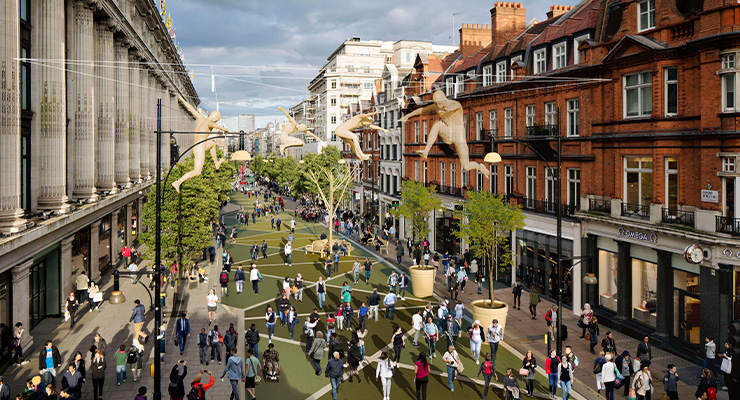
Having worked on numerous data and insights engagements focused on Oxford Street and the wider West End over the years, including forecasting the potential impact of previous public realm improvement proposals, it was particularly exciting to see Oxford Street Development Corporation (OSDC) finally begin the pedestrianization of the street.

After years of modeling what could happen, I now have the opportunity to observe what actually happens (and, of course, see how accurate some of those forecasts were!).
And the initial results are certainly encouraging.
An encouraging first week…
According to figures released by City Hall following the first traffic-free week, compared with the equivalent period in 2025:
- Footfall increased by 16% on the newly pedestrianized section.
- Retail spending increased by 28% across Oxford Street businesses included in payment provider Adyen’s analysis.
- Visitors stayed 5% longer on average in the pedestrianized section.
- Evening visits increased by 19% across the wider Oxford Street area.
- Market Halls on Oxford Street reported a 25% increase in sales and a 29% increase in footfall. [1][2]
Of course, we should be careful about drawing too many conclusions from a single week, particularly during half-term. But these are encouraging early indicators, especially when much of the planned streetscaping, public realm investment and activation is still to come.
Having previously worked on forecasting the benefits of improving Oxford Street, I have always believed in its enormous potential.
My analysis published in the 2024 Oxford Street: 2030 report, forecast that the previous £90 million public realm proposals could generate a 5–10% uplift in annual retail sales, with up to £2.8 billion in cumulative additional sales between 2027 and 2033 compared with a scenario without the improvements. [3]
These were forecasts for an earlier, different scheme rather than the pedestrianization now underway. But there was always a limitation with that scheme. Without full pedestrianization, we could improve the environment, but the opportunity to fundamentally transform how the street was used remained constrained. That limitation has now begun to be removed.
The benefits won’t stop at Oxford Street…
One of the things that has always stood out to me is the important role Oxford Street plays within the wider West End ecosystem. People don’t shop Oxford Street in isolation.
The Oxford Street: 2030 report found that at least 33% of Oxford Street visitors also visited Mayfair, Bond Street or Regent Street as part of their wider West End trip. [3]
This is significant because improving Oxford Street has the potential to generate benefits well beyond the pedestrianized area. If the transformation encourages more people to visit, stay longer and explore further, the resulting additional footfall, expenditure and activity could flow into neighboring streets, businesses and destinations.
Oxford Street already plays a substantial role in the district’s economy, representing approximately 35% of all West End retail sales. [3] But the opportunity isn’t just to grow Oxford Street’s own commercial performance. It’s to strengthen the attractiveness and performance of the wider West End. And I think this wider halo effect should be a fundamental consideration when assessing the long-term impact of pedestrianization.
The halo effect isn’t just physical. It’s digital too…
In October last year, I wrote a LinkedIn article about the one-day This is Oxford Street pedestrianization event, exploring how we need to think differently about the value created by places. The analysis focused on a one-day pedestrianization of the street.
The event generated a 45% increase in footfall compared with the previous Sunday, alongside a 25% increase in passenger movements at nearby Underground stations. [4] But at Portland Design, we were interested in understanding the value generated beyond the physical street.
Using AI-powered social listening from Placemaking AI, we explored the wider digital impact of the event, estimating that in just 24 hours it generated:
- 5.3 million in estimated digital audience reach.
- £178,000 in estimated earned-media value.
- Predominantly positive online sentiment, with conversations reflecting excitement, nostalgia and pride. [5]
These were estimates of digital exposure and media value, rather than additional sales. Nevertheless, they demonstrated how the value of an activation can extend far beyond the people physically attending it. The impact of a place is no longer confined to who visits and spends. It is amplified by who shares, posts and engages with it.
And Oxford Street is already demonstrating what this can look like. Future Stores, at the eastern end of Oxford Street, provides a particularly interesting example of how physical retail space can become an experiential brand and media platform.
According to Future Stores’ own published figures, its 2025 brand activations generated more than 203,000 store visits and 300 million organic views through creators and community sharing. [6]
These are operator-reported results, but they illustrate the potential for physical experiences to generate engagement far beyond their immediate location.
Now consider what permanent pedestrianization makes possible. Space previously occupied by buses, taxis and other traffic has become an entirely new resource.
What was once roadway now has the potential to become a commercial, cultural and experiential asset, creating value for stakeholders and brands in both the physical and digital worlds.
Well-curated events, cultural installations and brand activations could transform parts of Oxford Street into destinations in their own right, while generating content and engagement that reaches audiences around the world.
This also challenges how we traditionally measure the success of commercial destinations. Footfall, transactions and retail sales remain important, but they capture only part of the value created. Increasingly, we need to consider the wider physical, digital, experiential and economic impact.
Pedestrianization unlocks the potential. Now the hard work begins…
As excited as I am about pedestrianization, I think it’s important to recognize that removing traffic is only the beginning.
The newly available space creates enormous opportunities for more ambitious streetscaping, landscaping, cultural activity and activation. Food and beverage should also play an important role, with spaces to eat and drink helping to extend dwell times and encourage visitors to spend more time on the street.
But ultimately, Oxford Street’s long-term success will be defined by how effectively its commercial mix, public realm and overall experience evolve to meet the needs of its diverse audiences. Residents, workers, Londoners and international visitors all have different expectations, and the challenge will be to create a destination that offers compelling reasons for each to visit, spend time and return.
Getting this right will require a clear vision and a willingness to continually test, learn and adapt. Using data to understand changing visitor behaviors, experiences, spending patterns and perceptions will be fundamental to informing decisions and responding to what works, and what doesn’t.
The first week’s results are encouraging, but they are only the beginning.
Pedestrianization has unlocked Oxford Street’s potential. Now the real work begins in creating a place that people genuinely want to spend time in, and one that delivers lasting value for the wider West End.
Sources and references:
[1] City A.M. (9 November 2026), Oxford Street pedestrianisation brings ‘staggering’ shopping boost. First-week results based on City Hall and Adyen data.
[2] The Independent (9 November 2026), Customer spending on Oxford Street up since pedestrianisation. First-week statistics, including Market Halls results.
[3] New West End Company / Colliers (March 2024), Oxford Street: 2030. Historical visitor crossover analysis, retail sales and forecasts for the previous public realm proposals. Read Colliers’ report announcement.
[4] Mayor of London (6 October 2025), Results from the one-day This is Oxford Street event.
[5] The future of placemaking measurement: How AI reveals the full value of places. Portland Design / Placemaking AI analysis.
[6] Future Stores (2026), Operator-reported 2025 activation performance.