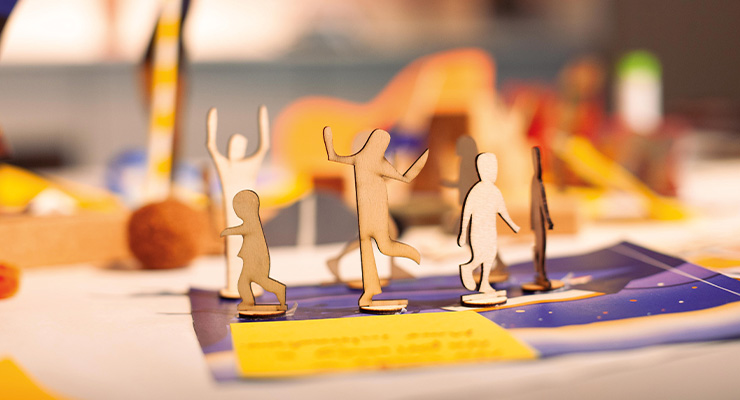
What and for whom are place for? And how will they be perceived? As a location to pass through? A coffee stop, a meeting point, a refuge? Portland Design argues that placemaking needs to take much more account of the people who enter a space, and of the very different experiences they may have there.

“The way a space makes you feel is not incidental to its design. It is the design,” she says.
Somebody may walk into a café on the way to work, with ten minutes before the next appointment. Later that day, the same person may return to the same café with more time and a different purpose. The café has not changed. But the situation has. And so has the experience.
The same place may feel completely different depending on who someone is, what they are doing, how much time they have, or how they are feeling.
Portland Design and Perkins&Will have been exploring this gap through empathy and perception. At the heart of it is an uncomfortable proposition: places are often designed from an idea of people rather than from the people themselves. People are not separate from their environment. Their lived experience is part of it. The experience of a place is produced in the encounter between the person and the environment, and that encounter is different every time.
Different states of mind
Empathy is often treated as an ability to imagine what somebody else might need. But imagination has limits. We tend to project our own experience onto other people, even when we are trying not to.
Portland Design’s approach is more demanding: getting into someone else’s shoes means making space for their experience.
“Incorporating empathy into design is, at its core, a question of system change. In order to have the luxury to care enough, the systems that support design need to change first.”
The problem is not simply a lack of designer goodwill. It is built into the way projects are organized. Decisions are made within budgets, programs, and established processes, while consultation can happen after many important choices have already been made. Organizations tend to be better at paying for problems once they become visible than at paying to prevent them.
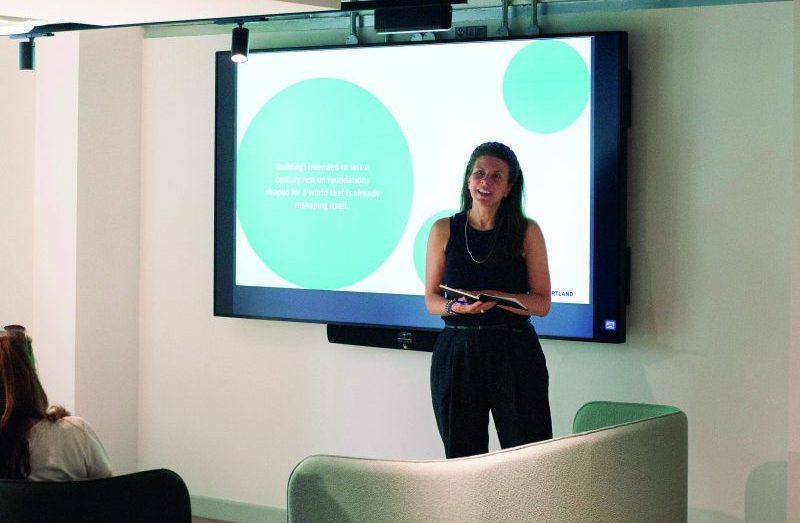
Empathy therefore has little chance if it is left to an individual designer. It must be possible within the system. That means asking who is involved early enough to influence a decision and recognizing that the people affected by a building may live with its consequences for much longer than the design team spends creating it.
The person for whom we are designing, meanwhile, does not remain the same. Someone becomes a parent. Someone gets older. Someone breaks an arm. Someone’s eyesight changes. A person who once rushed through a building may later need to move more slowly. The building stays.
Evidence gets old, too
Design relies heavily on what is already known. Guidelines, standards and research are built on previous experience. But buildings are designed for the future. Portland Design describes the problem succinctly: evidence has an expiry date.
The issue is not just demographic change. It is also what we choose to measure. A plan can tell us whether a corridor is wide enough. It tells us much less about whether someone feels confident walking down it. Yet confidence, wellbeing, or stress can determine how people actually use a place.
Portland Design points toward emerging ways of getting closer to those responses, from heart-rate monitoring and brain scans to thermal measurements and emotional tracking. AI and robotics could also make more individualized solutions increasingly viable.
At UCL PEARL, researchers have built a full-scale supermarket to show staff what the shop floor feels like to an autistic customer, and designed an e-scooter warning sound by measuring heart rate and brain activity in people with sight loss, hearing loss, and neurodivergence. The tools exist. What is still rare is using them early enough in a commercial project to change the outcome.
Designing from the edges
One of Portland Design’s more interesting propositions is to turn the conventional hierarchy upside down: Why start with the average and then try to accommodate everyone who falls outside it?
Designing for someone with one arm, for example, can also help someone with a broken arm or a parent carrying a child. A solution that begins with a very specific situation can turn out to be useful far beyond it.
The same thinking applies to dementia. Some design approaches intended for people living with dementia have been based on assumptions about what they need rather than on asking them what actually helps.
Portland Design and Perkins&Will invited Sebastian Crutch, Professor of Neuropsychology at the Dementia Research Centre, UCL Queen Square Institute of Neurology, to one of their roundtables. His research with people living with a visual form of Alzheimer found that a bend in a corridor roughly doubled the time they needed, while the brighter lighting and guiding cues usually recommended either made no difference or got in the way. What helped was legibility: fewer decisions, clear sightlines, even light. That is a description of a good place for anyone. The lesson is that you find out what helps by testing it with people, not by assuming.
People at the edges are not necessarily permanent members of an “edge” group. Most of us will experience some form of temporary limitation during our lives. We may carry a child, recover from an injury, struggle with mobility, or experience sensory overload.
And aging is not a fixed condition either. The people who will be considered old in twenty or fifty years will have grown up with different technologies, habits, and cultural expectations than today’s older generation. Designing for them cannot simply mean projecting today’s assumptions forward.
We don’t all see the same place
Our brains do not simply record the world around us. They construct it. Culture, childhood, cognitive differences, sensory loss, and physical differences all contribute to the way people construct their surroundings.
A designer sees a bright, open retail environment. Someone else sees glare. One person hears atmosphere. Another hears noise. One visitor appreciates the information on a screen. Another cannot process it quickly enough.
The difference is not necessarily in the space. It is in the encounter.
Tactile paving does exactly what it is meant to: it tells someone with a visual impairment where the kerb is. For someone using a walking frame or a wheelchair, the same surface can be uncomfortable or destabilising. A polished floor works in a similar way. Most visitors read it as clean and premium. Someone living with dementia may read it as wet or slippery. Same surface, very different outcome.
This is one reason why the sensory dimension of placemaking deserves more attention. Retail has become exceptionally sophisticated at creating visual environments. Architecture, lighting, digital screens, branding and visual merchandising all compete for attention. Sound, smell, shadow, and the less obvious effects of light are often treated as secondary. Yet they can determine whether a place feels stimulating or exhausting.
“Evidence has an expiry date.”
The problem is rarely one thing. It is the layering: music over announcements, moving screens, hard surfaces that carry sound, bright light with nowhere darker to retreat to. Each is specified separately; nobody experiences them separately. What gets overlooked is the pause, a place to stop without being asked to buy, look or decide.
Leaving room
There is a subtle difference between designing a place that accommodates people and designing one that gives them some control over their experience. Portland Design uses the word agency for this.
The idea is straightforward: people should be able to choose, navigate, and inhabit a place on their own terms. It changes the question from “Does this space work for everybody?” to something closer to “How many different ways are there of being here?”
This offers a different interpretation of inclusion. The objective is not necessarily to make everybody experience the same place in the same way. It is to avoid making one particular experience the only available one.
That may be especially important in public space. Nobody can opt out of a station, a high street, or a shopping center in quite the same way they can opt out of a private environment. The place has to accommodate differences without becoming a collection of visibly separate solutions.
What is the definition of normal?
The temptation is to simplify. A standard is easier to specify than a range of possible experiences. A target group is easier to define than a constantly changing population. But the idea of a universal human experience is difficult to defend.
Portland Design’s position is deliberately uncompromising: design either includes or excludes. There is no neutral position.
The important question is not whether every possible person can be represented in every decision. It is whether enough different experiences enter the process early enough to challenge the assumptions being made.
That means looking beyond the people who are normally part of the consultation process.
“Children, almost always. Carers, who experience a place on someone else’s behalf. The people who clean it, secure it, and open it at six in the morning. And the people who no longer come, because the place has already told them it isn’t for them. They are the hardest to consult, precisely because they are absent. What I would change is timing: involve people while decisions are still open, pay them for their time, and keep listening after opening day.”
Design does not stop at opening day. People will use a building differently from the way the drawings predicted. They will find their own shortcuts, meeting points, and favorite places. They will ignore some features and turn others into something the designers never intended.
Portland Design therefore sees space less as a finished product than as something ongoing, with a feedback loop between people and the environment throughout its life. For retail real estate, that idea is not insignificant. Formats change. Tenants change. Technology changes. Consumer habits change. Cities change. Why should the assumptions embedded in the physical environment be any more permanent?
A different idea of placemaking
Perhaps the most interesting consequence of all this is that it makes placemaking less about predicting people and more about leaving room for them.
The commuter and the child with the cake are the same person. They simply encounter the place differently. Perception complicates things further. Even when two people are looking at the same thing, they may not experience the same thing.
People change. Their circumstances change. Their expectations change. The evidence changes. The building remains.
This is why empathy cannot simply be an attribute of the designer. Portland Design sees it as something that needs to be built into the wider system around design, including the way projects are funded, commissioned and evaluated.
Nor is inclusion a matter of finding the perfect standard. The more interesting ambition may be a place that can accommodate difference without making difference the organizing principle of the space.
“If there is one assumption about people that I would like the placemaking industry to abandon is that everyone is having the same day.”