
Is retail real estate dead? Gone? History?
For an extended period, investors behaved as though the answer might be yes. Capital moved elsewhere, valuations were reset and the market entered a prolonged period of correction.
What happened next was less dramatic, but more consequential: the board changed.
Retail became smaller, more polarized and more transparent. Retailers became more selective. New development largely disappeared in many markets. Obsolete space was repurposed. Rents were rebased. And investors became much more precise about the difference between an asset with a future and one whose problems could no longer be solved through additional capital.
Now the players are moving again.
Not all of them, and certainly not everywhere. The European retail investment market remains highly selective, and economic and geopolitical uncertainty has by no means disappeared. But the tone has changed. Investors who had once questioned whether retail belonged in institutional portfolios are looking at the sector again. Some are buying. Others are repositioning existing portfolios. Increasingly, they are prepared to accept risk when the opportunity is clear.
The important point is that they are not returning to the old retail market.
They are investing in the one that emerged from the reset.
The Correction Changed The Game
Retail did not enter the current recovery from the same starting point as other property sectors.
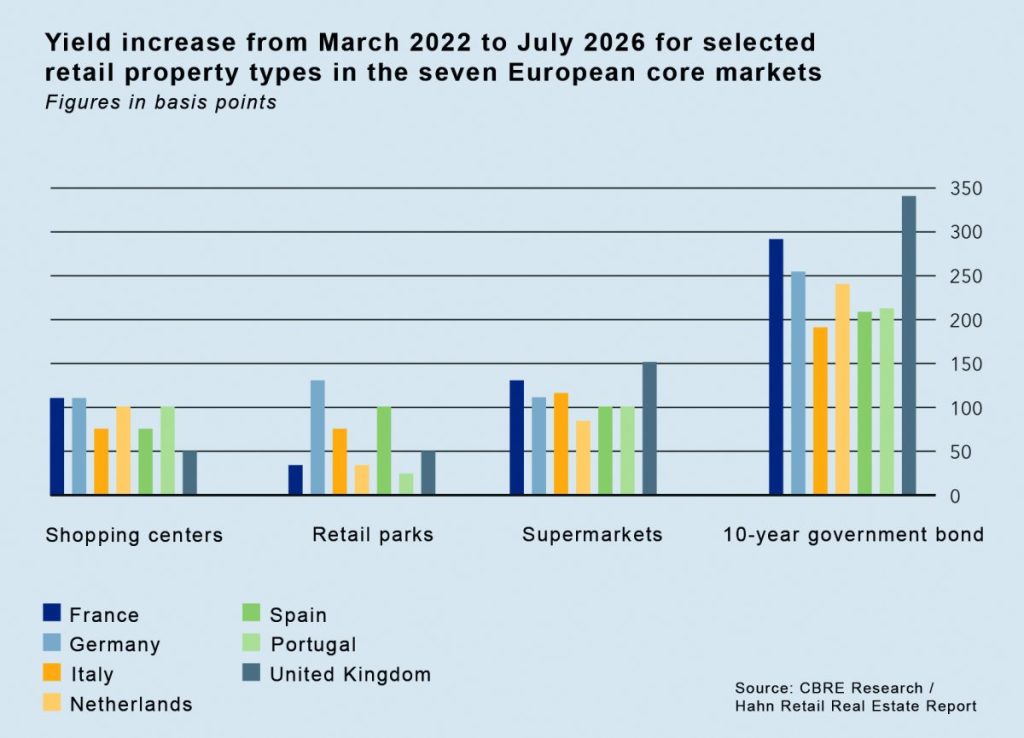
The structural impact of e-commerce was already forcing investors to reassess the sector before the pandemic, while the subsequent rise in interest rates triggered another round of repricing. Retail therefore went through a substantial correction relatively early.
Roman Müller, Head of Investment Management Retail at Union Investment, described the market‘s position in an ACROSS interview earlier this year:
“Revaluation in retail began earlier, which is why we are seeing earlier recovery as well.”
What matters now is what that correction has left behind. Investors have a much clearer understanding of which locations remain structurally strong, which formats provide defensive income and where there is sufficient potential to create additional value. The broad label “retail” has consequently become much less useful.
Union Investment’s own strategy reflects this shift, distinguishing between two broad poles: convenience and destination. Grocery-anchored retail and retail parks represent one; dominant shopping centers and prime metropolitan high streets the other. What matters is not the format itself, but the strength and clarity of its positioning.
That distinction increasingly defines the market.
Location is the First Move
Across Europe, investment decisions are becoming more granular. The question is no longer simply whether retail is attractive, but where it is attractive, what role an asset plays in its catchment and how much room remains to improve it.
This is visible in the growing interest in food-anchored retail and retail parks. Their comparatively predictable cash flows, accessible locations and everyday relevance make them easier to underwrite. The Hahn/CBRE survey of German market participants shows just how strong that preference has become: among investors planning acquisitions, retail parks and neighborhood centers were by far the most frequently named target segment, followed by supermarkets and food discounters.
But defensive income is only one side of the story.
At the other end of the spectrum, dominant shopping centers and prime high streets are attracting attention precisely because their position gives them scope to evolve. The strongest assets can strengthen their role within a city or region by improving tenant mix, adding food and beverage, leisure, healthcare, offices or other services.
The common denominator is relevance.
Christoph Andexlinger, CEO of SES, describes the investment logic in similarly straightforward terms. For SES, the starting point is whether an investment can maintain or increase a location’s relevance. Economic viability follows, with ecological viability now inseparable from it.
That is a very different way of looking at value than simply asking what an asset is worth today.
The Shopping Center Is Back In Play
Few retail formats illustrate the change in investor thinking more clearly than the shopping center. For years, the category was often treated as a structural problem rather than an investment opportunity. That assessment was understandable. Some centers had lost tenants, footfall and relevance simultaneously. In weaker locations, no amount of refurbishment could restore the original proposition.
But the correction also created a sharper distinction between centers that can adapt and those that cannot.
The first group is once again attracting capital.
Recent transactions and investor strategies point toward a market in which dominant assets can justify substantial investment when their catchment, tenant demand and long-term positioning provide a credible basis for growth. NEPI Rockcastle, for example, approaches acquisitions with an explicit focus on location fundamentals and the potential to enhance value after purchase. Its investments in Forum Gdańsk, Magnolia Park and Silesia City Center generated significant valuation uplift through active asset management.
That does not make the shopping center a low-risk asset. Quite the opposite.
Transformation requires capital, operational expertise and a willingness to think beyond the existing retail mix. But for the right property, that complexity can itself create an investment opportunity.
The future of the shopping center is therefore unlikely to be defined by a single format. Some will become more dominant destinations. Others will become smaller, more local or more mixed-use. Some will disappear altogether.
The investment case lies in knowing which is which.
A Smaller Market Can Be A Better Market
One of the less obvious consequences is that Europe‘s physical retail market has simply become smaller.
The overall footprint is shrinking. Redundant space is being converted. New development has largely evaporated in many mature markets. Construction and financing costs make large-scale speculative development considerably harder to justify than in previous cycles. Savills describes this as part of a broader “retail reset”: the weaker space is being removed while stronger pitches retain or regain pricing power.
For investors, this changes the supply equation. Scarcity does not automatically make an asset valuable. But in a market where new competing supply is limited, a strong existing location has a different strategic position from one that would previously have faced continual competition from new development.
This is one reason the current recovery cannot simply be measured through transaction volumes. What matters is whether investors are regaining confidence in the underlying income and growth potential of selected assets.
European retail investment rose from €26.6 billion in 2023 to €34.6 billion in 2024 and €39.4 billion in 2025. The first half of 2026 was slightly below the exceptionally strong previous-year period, but remained well above the market’s low point.
The message is not that retail has returned to its old volumes.
It is that the market has become investable again on different terms.
Capital Is Becoming More Active
The clearest sign of this shift may be the behavior of investors themselves.
The German retail investment survey conducted for the Hahn Retail Real Estate Report shows the highest acquisition interest since 2023. Nearly half of respondents intend to expand their retail holdings over the following twelve months, while only 12 percent plan to reduce them.
At the same time, the appetite for risk is changing only gradually. Core remains dominant, but Core-Plus and more selective value-oriented strategies are gaining ground.
This is important. The returning capital is not indiscriminate capital. Investors are demanding more from an asset before committing to it. They are looking at tenant quality, lease structures, catchment dynamics, capital expenditure, sustainability and the ability of a property to adapt over time.
In other words, investment and asset management are becoming harder to separate. The investor is increasingly required to think like an operator. That applies particularly to assets with transformation potential. Buying cheaply is not enough. The value creation plan has to be credible, funded and executable.
The same logic applies to sustainability. Energy efficiency, technical systems and climate resilience are no longer issues that sit outside the investment equation. They influence operating costs, future capital requirements and, ultimately, the value of an asset. Research by Chiara Künzle also shows how climate-related risks can already translate into measurable differences in retail property values.
Relevance Has A Value
This may be the most important change of all.
Retail investment is increasingly being judged according to what an asset can contribute to its location, rather than simply what category it belongs to.
That is particularly clear in SES’s investment philosophy, Andexlinger explains. The company looks first at what people in the catchment need and what will remain relevant in the future. Investment follows where the asset can maintain or increase that relevance.
The same principle can be seen across the market, from neighborhood retail to dominant shopping destinations.
A retail park can be valuable because it is convenient, accessible and difficult to replace. A shopping center can be valuable because it is the dominant destination for a large region. A high street can be valuable because its location remains unique. The physical format matters, but the role it plays matters more.
That also explains why the strongest investors are looking beyond retail in the narrow sense.
Healthcare, leisure, gastronomy, education, offices or other uses can strengthen a destination where they respond to genuine local demand. They are not valuable simply because they make an asset “mixed-use.” They are valuable when they increase the relevance and resilience of the place. SES, for example, has integrated healthcare and other uses into selected destinations where they support the wider proposition.
That is where capital and placemaking increasingly meet.
A Different Kind Of Confidence
The retail investment market is therefore entering its next phase with considerably more confidence, but also with considerably less room for error.
The old retail market rewarded scale, growth and capital availability. The new one rewards clarity.
Investors need to know why a location matters, which customers it serves, what competition it faces and what can realistically be improved. They need to understand not only the asset, but the ecosystem around it.
That makes today’s market more demanding. It also makes it more interesting.
There is no broad-based return to retail. There is something more useful: a return to selectivity. Capital is coming back because investors can see more clearly where retail works, where it can be transformed and where it no longer has a credible future.
The board is filling up again.
But this time, the winners will not be determined by who can make the biggest move.
They will be determined by who understands the position.
Originally published in ACROSS Magazine Issue 3/2026
Explore the complete edition and download your digital copy now.