

Written by
Peter Sempelmann
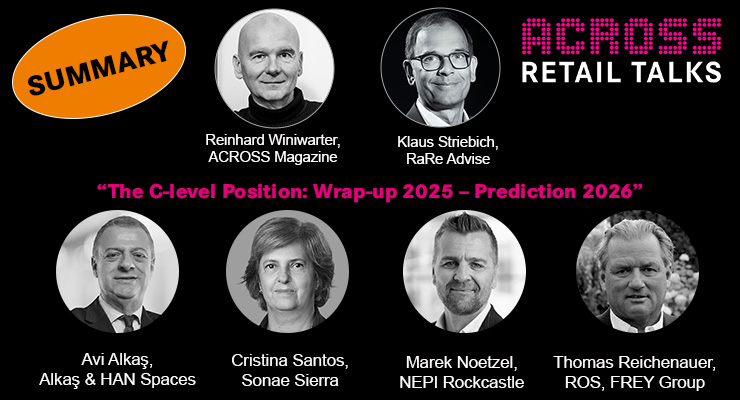
As the year 2025 is nearing its end, ACROSS invited four industry leaders – Avi Alkaş (Alkaş & HAN Spaces), Cristina Santos (Sonae Sierra), Marek Noetzel (NEPI Rockcastle), and Thomas Reichenauer (ROS Retail Outlet Shopping / FREY Group) – to a final Retail Talks. To evaluate the retail and placemaking industry’s past 12 months and to give an outlook of what’s next.
Read a short summary of the Retail Talk and relive the Retail Talks from December 2nd 2025.
2025: A Year of Structural Learning
Looking back, 2025 was described as a year of recalibration. The real estate and retail industries spent 2025 consolidating and preparing for what comes next. There was unanimous agreement that 2025 offered deep learnings – particularly regarding operations, customer behavior, and digital transformation.
Key takeaways from 2025 revolved around efficiency, customer understanding, and the need for speed. Operators reduced energy costs dramatically, integrated advanced digital tools, accelerated decision cycles, and shifted from adding GLA to improving performance per square meter.
Video: ACROSS Retail Talks
2026: Spot on Customer Centricity
The panel agreed that 2026 will be shaped by customer-centric strategies powered by data, AI, and operational agility. Seven main points were outlined during the ACROSS Retail Talks:
1. Prioritize Customer-Centricity – For Tenants as Well as Visitors
- Treat tenants as primary customers: simplify leasing, reduce friction, accelerate approvals.
- Enhance visitor experience with stronger F&B, social spaces, and localized offers.
2. Invest in Scalable Technology – Not Experiments
- Choose AI and digital solutions that work across countries and asset types.
- Focus on operational tools that reduce energy use, automate admin, and enhance data quality.
- Strengthen omnichannel analytics to understand behavior and drive targeted marketing.
3. Strengthen Energy & ESG Capabilities
- Implement smart-building systems (HVAC, lighting, predictive maintenance).
- Expand renewable installations where ROI is clear.
- Position ESG investments as value drivers and differentiation for tenants and capital markets.
4. Optimize Asset Performance Before Expanding
- Improve performance per square meter, redesign underperforming areas.
- Shift GLA allocations toward experience: F&B, leisure, services, and hybrid retail concepts.
- Integrate community-relevant uses to increase dwell time and loyalty.
5. Prepare for Strategic Acquisitions & Extensions in 2026
- Capital-strong players will find opportunities in valuation gaps and selective distress.
- Focus on assets with strong fundamentals: dense catchments, tourism flows, or dominant regional positioning.
6. Build Destination Value – Especially for Outlets
- Outlets should deepen F&B, local gastronomy, night-time economy, and tourism partnerships.
- Co-development models (e.g., outlet + retail park + leisure + hotel) increase resilience.
7. Maintain Human Experience as the Core
- AI enhances efficiency, but emotional connection and physical experience drive value.
- Train teams for agility, creativity, and service excellence.
Conclusion: Focus on Value
2026 may bring opportunities due to valuation gaps and selective distress. NEPI, FREY/ROS, Sonae Sierra and Turkish investors are all preparing for acquisitions, extensions, and redevelopment – but with increasingly strict criteria for quality and future-proofing.
Overall, 2026 is expected to be a year of implementation, targeted investment, and strategic opportunity, as well-capitalized players prepare for selective acquisitions and redevelopment projects. Despite global uncertainties, the sentiment was clear: the industry enters 2026 with cautious optimism and a sharpened focus on value creation.