

By Liliya Shaykhutdinova
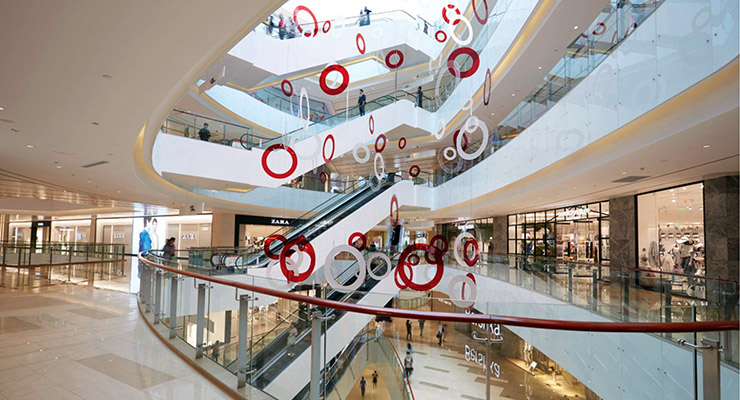
For decades, shopping centers were designed to move people horizontally. Upper floors were often treated as a challenge rather than an opportunity. Yet across Asia, some of the most successful malls operate across seven, ten, even thirteen levels, and manage to drive footfall upward with remarkable consistency.
During a consulting project, I analyzed how these vertical malls work in practice. What stood out was not a single design trick, but a clear philosophy: verticality is planned, programmed, and monetized as part of the customer journey. Height becomes an advantage rather than a limitation.
1
What Defines a Vertical Mall?
A vertical mall is a shopping center organized across multiple stacked levels, where each floor plays a defined role in the overall experience. Unlike traditional horizontal malls, which rely on lateral circulation and anchors at the ends, vertical malls are conceived around upward movement from the outset.
Driven by dense urban conditions, many Asian malls deliberately use food, entertainment, culture, and services to pull visitors up through the building. These elements are not concentrated in a single zone or placed only at the top, but distributed strategically across levels to create repeated reasons to move upward.
2
Location and Planning Still Matter
No concept works without a strong location. Connectivity, visibility, surrounding density, and integration with daily urban life remain essential. Vertical malls succeed because they are embedded in high-footfall environments.
Equally important is planning. Traditional malls tend to manage vertical circulation as infrastructure. Asian malls design vertical journeys. Escalators are visible and frequent, atriums create strong sightlines, and movement between floors feels natural rather than forced. Wayfinding, zoning clarity, and intuitive sequencing reduce psychological distance between floors, making higher levels feel closer than they physically are.
3
A Different Logic of Tenant Mix
In many traditional malls, retail dominates lower floors, food is clustered in a single zone, and entertainment is isolated. Upper levels often depend heavily on anchor tenants.
Vertical malls take a layered approach. Retail, dining, and leisure are interwoven across multiple floors. Food appears repeatedly throughout the building, curated by occasion, from everyday cafés to destination restaurants and rooftop venues. Upper floors are experiential by default.
The key shift is that mixed-use stacking replaces functional stacking.
4
Food, Culture and Lifestyle Anchors
Food and beverage plays a central role in vertical activation. In mature Asian malls, F&B can account for up to 30 percent of GLA and is distributed vertically to support footfall throughout the day and evening.
Cultural and community uses, such as libraries, galleries, learning centers, and event spaces, are integrated into the retail logic rather than added later. Health, wellness, and service-oriented tenants act as lifestyle anchors, generating regular, appointment-driven visits and supporting daily relevance. Market-style food halls and culturally authentic concepts coexist with international brands, allowing malls to appeal to tourists while remaining embedded in local routines.
5
Resiliance Trough Diversity
Vertical malls are typically more resilient than traditional formats. By combining luxury and mass-market brands, authentic local concepts and global names, and retail with experience-led uses, they attract a broad audience and reduce reliance on single anchors.
Pop-up and hype-driven concepts further reinforce vertical movement. Limited-edition stores and collaboration spaces placed on upper levels turn novelty into a reason to go up. Fans are willing to travel vertically for these experiences, often combining them with dining or leisure, extending dwell time and generating buzz.
6
Children and Edutainment
The children’s segment in has evolved beyond traditional play areas toward edutainment. Clubs, activity centers, language schools, creative studios, and music classes are frequently located on mid- or upper-level floors, giving parents a clear reason to move vertically. Unlike soft-play zones, which are often occasional and convenience-driven, edutainment is appointment-based and repeat-oriented, supporting weekday traffic and longer dwell times.
7
Markets, Kiosks and the Power of Informality
And the last, but not the least – one more effective yet often underestimated tool in vertical malls is the use of market-style formats. Kiosks, booths, temporary stalls, and semi-permanent market concepts introduce informality, spontaneity, and constant visual change into the mall environment.
These elements encourage impulse purchases, shorten decision-making time, and create a sense of discovery as visitors move between levels. Because they are flexible and easy to rotate, they help maintain a feeling of freshness and give customers new reasons to explore upper floors repeatedly. In vertical environments, this market feel plays a crucial role in reducing fatigue and sustaining curiosity across multiple levels.
8
Making Height Work
The experience of successful vertical malls demonstrates that height, in itself, is not a structural weakness. When vertical circulation, tenant mix, pricing strategy, and programming are aligned, upper floors can perform as strongly as lower levels and, in many cases, become destinations in their own right.
Asian vertical malls illustrate a clear shift in mindset, from treating upper floors as overflow space to designing them as integral parts of the customer journey. Through layered tenant mixes, vertically distributed food and lifestyle offers, experience-led circulation, and flexible formats such as pop-ups and market-style kiosks, these malls create continuous reasons for visitors to move upward.
For other markets, the key takeaway is not replication, but adaptation. The principles behind vertical success, intentional planning, diversified audiences, experiential layering, and ongoing reprogramming, can be applied to any multi-level shopping center seeking to improve upper-floor performance and long-term resilience.

Liliya Shaikhutdinova
Liliya Shaikhutdinova is leasing manager at Marina Mall, part of National Investment Corporation (NIC), Abu Dhabi. She previously served as COO and Center Manager of Tashkent City Mall, and held Center Manager roles with ECE in Moscow. Earlier in her career, she worked as Tenant Manager with Ingka Centres in Moscow and Ufa. Liliya holds a PhD in linguistics and degrees in Management and Economics from Lomonosov Moscow State University.