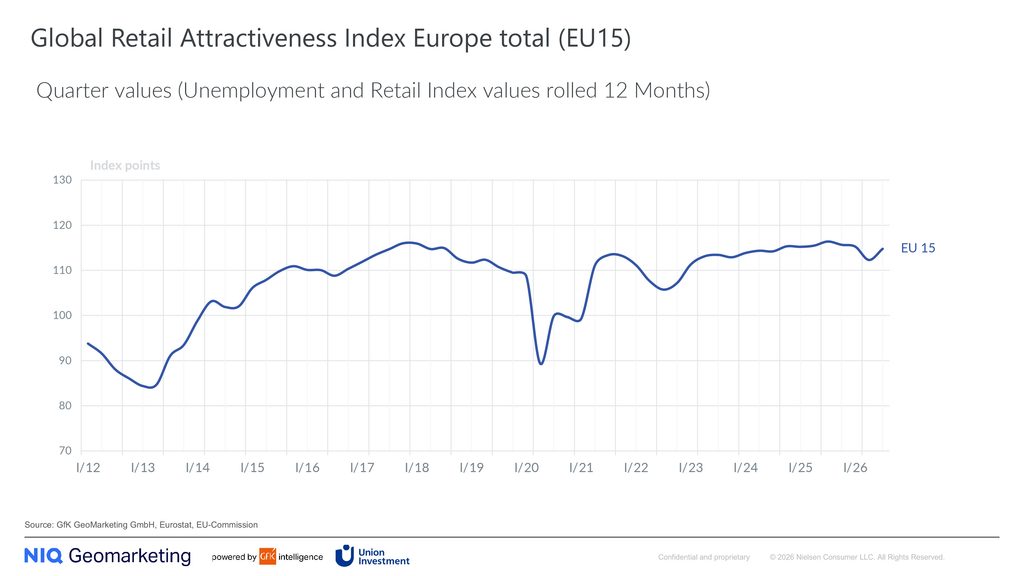
The latest Global Retail Attractiveness Index (GRAI), compiled by NIQ-GfK and Union Investment, brings some positive news for European retail. After two consecutive quarters of declining values, the Retail Attractiveness Index for the EU-15 recovered in the third quarter of 2026, reaching 114.8 points. This represents a modest year-on-year increase of 0.4 points and indicates that the European retail market has regained some of the ground lost during the first half of the year.

The recovery becomes particularly evident when compared with previous GRAI results. In the fourth quarter of 2025, the index had still been on an upward trajectory, reaching approximately 115 points. However, momentum weakened in the following quarters, with the index falling to around 112 points. This suggested that conditions for European retail were becoming increasingly challenging. The latest results now indicate that this brief downward trend has been halted, at least for the time being.
However, the improvement should not be mistaken for a broad-based economic recovery. While retail sales and retailer confidence have strengthened, consumer confidence remains below its year-earlier level. Labor market developments also continue to weigh on performance. European retail is showing signs of stabilization, but the recovery remains far from uniform.
Development of the Main Indicators in the EU-15
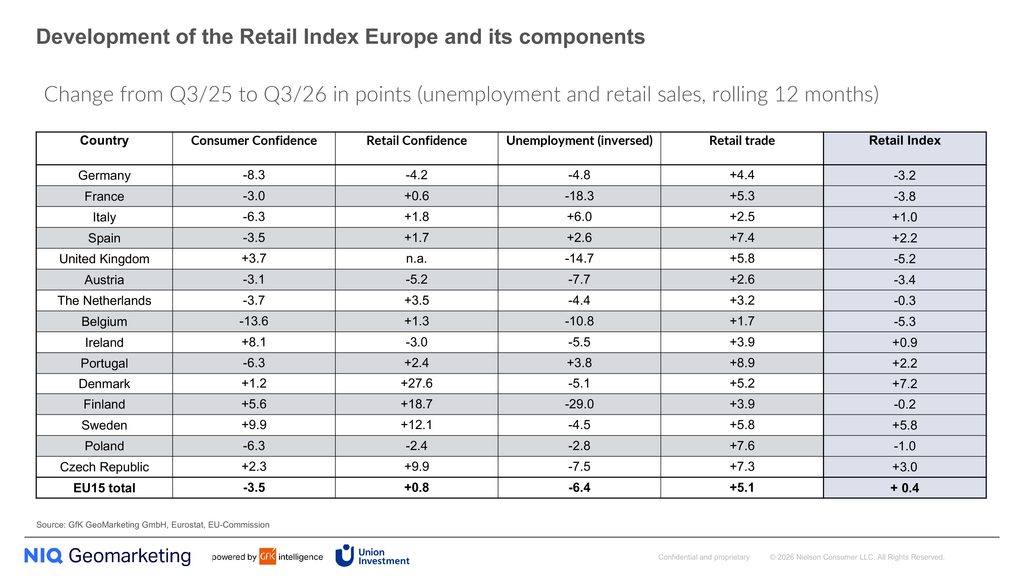
Year-on-year change, Q3 2025 to Q3 2026
- Consumer confidence: –3.5 points
- Retailer confidence: +0.8 points
- Unemployment (inverse indicator): –6.4 points
- Retail sales: +5.1 points
- Overall index: +0.4 points
The figures reveal a growing gap between sentiment indicators and actual retail performance. Sales remain the strongest positive contributor to Europe’s attractiveness, while consumer confidence and labor market conditions continue to constrain further improvement.
Retail Sales Remain Europe’s Greatest Strength
One of the clearest findings of the latest GRAI is that actual retail performance continues to hold up better than the more subdued sentiment indicators. Across the EU-15, the retail sales component increased by 5.1 points year-on-year, making it the strongest performer among the four index components.
This is also an important development compared with the first quarter of 2026. Even then, retail sales had provided a degree of stability to the European market. Their continued strength suggests that consumer spending has remained relatively resilient despite persistent economic uncertainty. For retailers and shopping center operators, this is a more encouraging signal than the confidence indicators alone might suggest.
The picture is relatively consistent across individual countries. All 15 markets recorded positive developments in retail sales over the past twelve months. Portugal and Poland posted particularly strong gains, followed by Spain and the Czech Republic. Germany and the United Kingdom also recorded solid increases.
However, higher retail sales have not automatically translated into stronger overall index scores. In several major markets, weaker consumer confidence and deteriorating labor market indicators have offset the positive contribution from retail activity.
The Strongest Annual Increases in Retail Sales
- Portugal: +8.9 points
- Poland: +7.6 points
- Spain: +7.4 points
- Czech Republic: +7.3 points
- United Kingdom: +5.8 points
- France: +5.3 points
- Denmark: +5.2 points
Northern Europe Leads the Recovery in Retailer Confidence
While the overall picture across Europe remains mixed, the Nordic markets are among the strongest performers in terms of retailer confidence.
Denmark recorded the largest annual increase in retailer confidence, gaining 27.6 points. Finland followed with an increase of 18.7 points, while Sweden gained 12.1 points. This continues a positive trend that was already evident in the first quarter of 2026, particularly in Denmark and Finland.
Consumer confidence is also showing signs of improvement across Northern Europe. Sweden recorded the strongest annual increase among the EU-15 countries, followed by Ireland. Denmark and Finland also posted positive developments. According to NIQ-GfK, the recovery in consumer sentiment coincided with recent improvements in labor market conditions in Finland and Denmark. In Sweden, the labor market has stabilized.
However, the recovery in the Nordic countries comes with a caveat. Finland’s labor market remains under considerable pressure, and the corresponding labor market component of the index has deteriorated further. This illustrates why improving confidence alone is not enough to bring about a significantly stronger overall index performance.
The Strongest Improvements in Retailer Confidence
- Denmark: +27.6 points
- Finland: +18.7 points
- Sweden: +12.1 points
- Czech Republic: +9.9 points
- Netherlands: +3.5 pointss
Poland and the Czech Republic Maintain Their Leading Positions
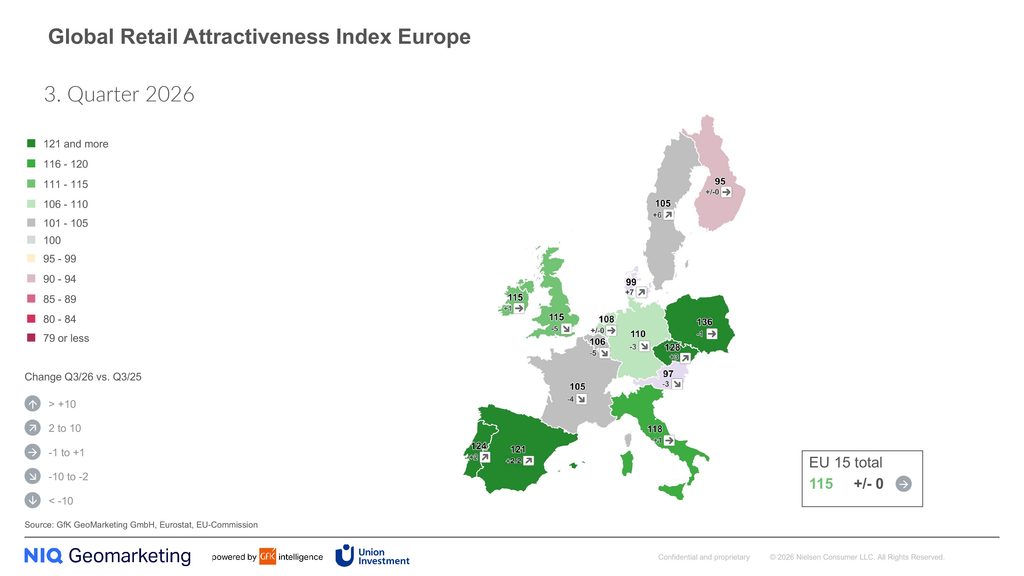
Looking at absolute national index scores rather than annual changes, two Central and Eastern European markets continue to occupy the top positions. Poland remains Europe’s most attractive retail market, with 136 points, followed by the Czech Republic with 128 points. Both countries are well above the EU-15 average of 114.8 points.
The Iberian Peninsula also continues to perform strongly. Portugal scores 124 points, while Spain stands at 121. In both countries, improvements in labor market conditions over recent years have supported the performance of the other index components. In Poland and the Czech Republic, labor markets have cooled. However, their longer-term convergence toward Western European standards has helped the two countries maintain their comparatively high index scores.
The latest results also underline the importance of distinguishing between absolute index levels and year-on-year changes. Poland, for example, remains Europe’s strongest market despite a slight decline compared with the previous year. Denmark, by contrast, recorded the largest annual improvement, although its overall index score remains below the European average.
This distinction matters to investors and retail real estate operators. Markets with the highest current attractiveness do not necessarily show the strongest short-term momentum, and vice versa.
“The latest results demonstrate just how broad the range of opportunities in the European retail real estate market has become. Poland, the Czech Republic, Iberia, and Italy stand out for their strong fundamentals, while Denmark and Sweden are showing clear signs of recovery. Investors can therefore find attractive entry opportunities both in established growth markets and in markets with catch-up potential. Their attention is increasingly shifting beyond the traditional core markets,” says Roman Müller, Head of Retail Investment Management at Union Investment.
Europe’s Leading Retail Markets
Global Retail Attractiveness Index, Q3 2026
- Poland: 136 points
- Czech Republic: 128 points
- Portugal: 124 points
- Spain: 121 points
- Italy: 118 points
Germany, France, and the United Kingdom Remain Under Pressure
Not all European markets are benefiting equally from the latest recovery. Some of the continent’s largest retail markets continue to face challenges. Germany, France, and the United Kingdom, three of Europe’s largest economies, all recorded year-on-year declines in their respective national indices.
In Germany, the index fell by 3.2 points to 110 points. The main factors were weaker consumer confidence and declining retailer confidence. Although retail sales increased by 4.4 points, this positive contribution was not enough to offset the deterioration in the other components.
France recorded an even steeper decline of 3.8 points, bringing its index to 105 points. The labor market indicator deteriorated particularly sharply, falling by 18.3 points. Consumer confidence also remained weak. Despite positive retail sales developments, the French retail market continues to face a challenging environment.
The United Kingdom recorded the steepest decline among the three markets, with its Retail Index falling by 5.2 points to 115 points. Notably, consumer confidence improved by 3.7 points. However, the labor market indicator deteriorated significantly, while retail sales continued to perform positively, increasing by 5.8 points.
Belgium recorded the largest overall decline among the EU-15 countries, with a decrease of 5.3 points. Its consumer confidence indicator fell by 13.6 points, the sharpest drop among all European markets surveyed.
The Largest Annual Declines
- Belgium: –5.3 points
- United Kingdom: –5.2 points
- France: –3.8 points
- Austria: –3.4 points
- Germany: –3.2 points
Europe Maintains Its Global Lead
The international comparison confirms Europe’s continued strength in the global retail landscape. Although North America and Asia-Pacific also showed signs of recovery in the third quarter of 2026, neither region comes close to matching Europe’s index level.
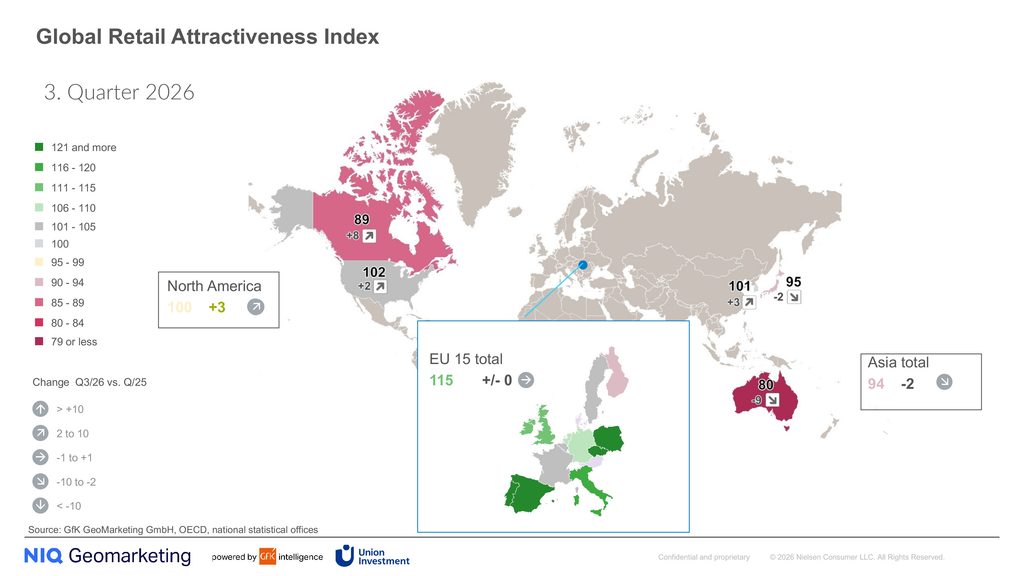
North America’s Retail Attractiveness Index increased by 1.8 points quarter-on-quarter to 100.4 points. This puts the region 2.9 points above its year-earlier level. Stronger retailer confidence and continued growth in retail sales supported this development. Canada recorded particularly strong annual gains, while the United States also improved.
Asia-Pacific recovered by 2.2 points quarter-on-quarter to 94.4 points, but remained 1.9 points below its year-earlier level. Consumer and retailer confidence improved compared with the previous quarter. However, weaker consumer sentiment and labor market indicators continued to weigh on the overall result.
The comparison highlights Europe’s sustained lead. At 114.8 points, the EU-15 stands more than 14 points ahead of North America and more than 20 points ahead of Asia-Pacific. This gap has also remained remarkably stable over the longer-term development of the GRAI.
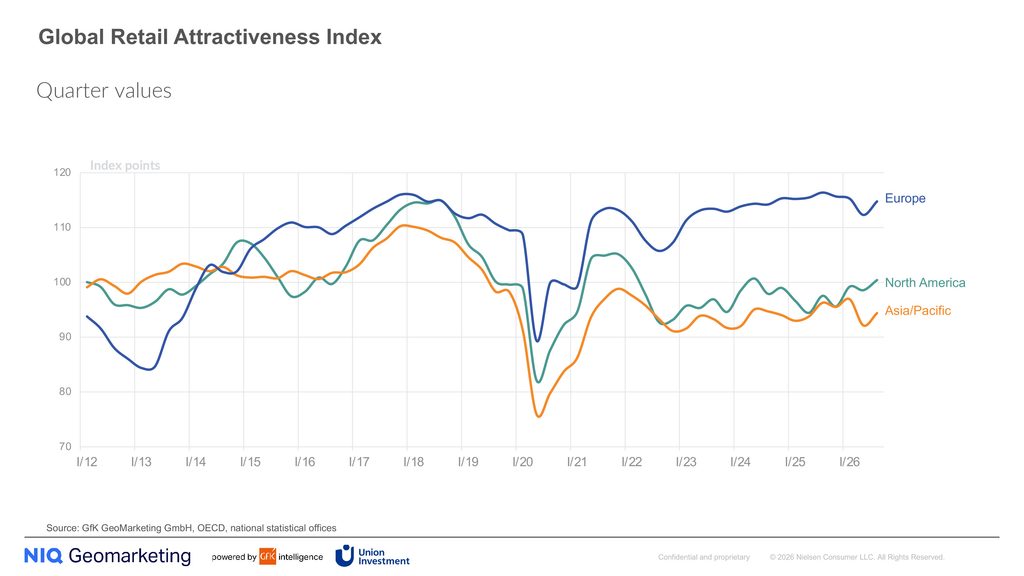
Global Retail Attractiveness Index, Q3 2026
- Europe (EU-15): 114.8 points
- North America: 100.4 points
- Asia-Pacific: 94.4 points
European Retail Is Stabilizing, but Challenges Remain
The latest GRAI results offer a cautiously optimistic outlook for European retail. The recovery in the third quarter of 2026 marks an important turning point after two consecutive quarters of declining index values. Robust retail sales, improving retailer confidence, and renewed optimism in several Nordic markets provide a solid foundation for further stabilization.
At the same time, the figures show that European retail continues to face significant structural and economic pressures. Consumer confidence has yet to return to its previous level, labor market conditions remain challenging in several countries, and differences in the performance of individual markets are becoming more pronounced.
The contrast between Poland and the Czech Republic on the one hand, and Germany, France, and the United Kingdom on the other, illustrates just how differently European retail markets are evolving. For investors, developers, and operators, this underlines the importance of looking beyond the overall European index and assessing individual markets in light of their specific economic conditions.
“European retail investment markets are caught between positive market momentum and a consumer and investment environment that remains highly differentiated. Overall, retail is back on the investment agenda and is regaining market share relative to other asset classes. However, the return of investor demand is unevenly distributed. Traditional, generally liquid core markets such as Germany and France are currently benefiting less than other European markets,” Müller says.
Europe has regained some upward momentum. However, the next phase of the recovery will depend on whether stronger retail activity also translates into renewed consumer confidence and more stable labor markets.
GRAI Methodology
The Global Retail Attractiveness Index combines four equally weighted indicators to assess the attractiveness of retail markets.
Qualitative factors
- Consumer confidence
- Retailer and business confidence
Quantitative factors
- Unemployment (rolling twelve-month changes)
- Retail sales (rolling twelve-month changes)
The indicators are standardized and converted to ensure comparability. A score of 100 represents the average. The theoretical range of the index is between 0 and 200 points. The overall EU-15 index is weighted according to the population of each country.