
The European outlet industry has come a long way. What began as a relatively specialized retail format has evolved into an established part of the European retail landscape, attracting international brands, investors, and millions of consumers. Yet, according to market expert Ken Gunn, the sector is entering another period of transition.
Presenting his latest assessment of the European outlet market at MAPIC in Cannes, the retail real estate consultant described an industry that continues to perform well but can no longer rely on the growth drivers that shaped its previous development.
His figures illustrate the sector’s resilience. Europe currently has 206 major outlet centers, comprising approximately 4.1 million sqm of gross lettable area. Together, they generate an estimated €23.4 billion in brand turnover. In 2019, the corresponding figures stood at 212 centers, 3.9 million sqm, and €18.8 billion in turnover.
Gunn stated that the apparent decline in the number of centers is not an indication of a shrinking market. He explained that the classification of smaller schemes has changed over time. More importantly, the figures demonstrate how much value the industry has created: turnover has increased substantially, while the overall amount of retail space has grown only moderately.
Nevertheless, the pace of growth is changing. After years in which annual turnover growth of 6% to 12% was not unusual, the industry is now experiencing more moderate development. Gunn estimates that European outlet turnover increased by approximately 5% in 2025, with growth in 2026 likely to be slightly lower.
Household budget pressures, subdued consumer confidence, higher operating costs, and limited development activity are all contributing to the slowdown.
Europe’s Outlet Industry at a Glance
- 206 major outlet centers
- 4.1 million sqm GLA
- €23.4 billion estimated brand turnover
- 28 European countries with outlet centers
- 71.8 million individual outlet shoppers
From expansion to asset management
Gunn describes the current phase as an age of innovation and asset management. The industry has moved through several distinct periods, from initial exploration and expansion to investment, post-pandemic recovery, and now the challenge of reinventing established assets.
Many outlet centers are 20 or 30 years old. They must adapt to changing consumer expectations, new generations, and increasingly demanding brands while continuing to deliver attractive returns for investors.
There is evidence that this process has already created considerable value. Gunn’s classification system divides outlet centers into five performance tiers, ranging from internationally recognized destinations to smaller local schemes. The higher the tier, the greater the potential sales density and brand quality.
“We are entering an age of innovation. Many outlet assets need to reinvent themselves to remain relevant to changing customers and generations.”
Ken Gunn
In 2019, Europe had 58 Tier 1 to Tier 3 centers. By 2026, that number had increased to 95. The most significant change occurred in Tier 3, which grew from 30 to 53 centers.
Moving an asset up the performance hierarchy can have a substantial impact on its value. Gunn estimates that each step up the hierarchy can make an asset approximately three times more effective in value terms.
This demonstrates the potential of targeted investment, refurbishment, repositioning, and improved merchandising. It also explains why asset management has become so important to outlet operators.
However, improving existing assets alone will not be sufficient to sustain the industry’s previous growth rates.
The Industry’s Evolution
| 2019 | 2026 | |
| Outlet centers | 212 | 206 |
| GLA | 3.9m sqm | 4.1m sqm |
| Estimated turnover | €18.8bn | €23.4bn |
| Tier 1-3 centers | 58 | 95 |
More value, better assets, and higher-performing destinations, despite relatively limited floorspace expansion.
Increasingly apparent development gap
One of Gunn’s central observations concerns the relationship between floorspace expansion and brand growth.
Before the pandemic, European outlet turnover grew by approximately 8% annually on average. New developments contributed significantly to this performance, creating additional space for brands, introducing new retail concepts, and giving consumers more reasons to visit.
That development pipeline largely disappeared following COVID-19. Although the market has recovered, new floorspace has not returned at the same pace.
The consequences are becoming increasingly visible. Brand growth has flattened, and the industry’s leading brands are taking up a greater share of available space.
In 2016, the 30 largest brands accounted for approximately 13% of outlet stores in Europe. By 2026, their share had risen to 16.3%.

This is positive in one respect. It demonstrates that outlet locations have become increasingly important to major international brands. Yet it also creates a problem: retail mixes across different outlet centers are becoming more similar.
For consumers who traditionally visited several outlet destinations in search of attractive offers and different brand selections, this standardization reduces the incentive to travel between centers.
Gunn believes that the industry needs more variety, not simply more of the same brands.
The latest brand rankings illustrate the continuing strength of established players. Levi’s has returned to the top position, followed by Guess and Puma. Crocs, Only, Starbucks, and Rituals recorded some of the strongest improvements in the rankings. Bestseller Group has expanded its combined outlet portfolio to 285 stores, 27% more than a year earlier.
Newcomers are also entering the market. The Label Yard opened at 11 locations, Jack & Jones Kids at seven, and HOKA made its outlet debut with five stores.
Nevertheless, overall brand activity was weaker than in previous years. According to Gunn, 803 brands adjusted their outlet portfolios in 2026, while the overall level of activity was 7% below 2025.
The challenge for operators is increasingly about finding the right balance between securing established international brands and maintaining enough differentiation to make each destination distinctive.
The 90% opportunity
Perhaps the most provocative part of Gunn’s presentation concerned the industry’s customer base.
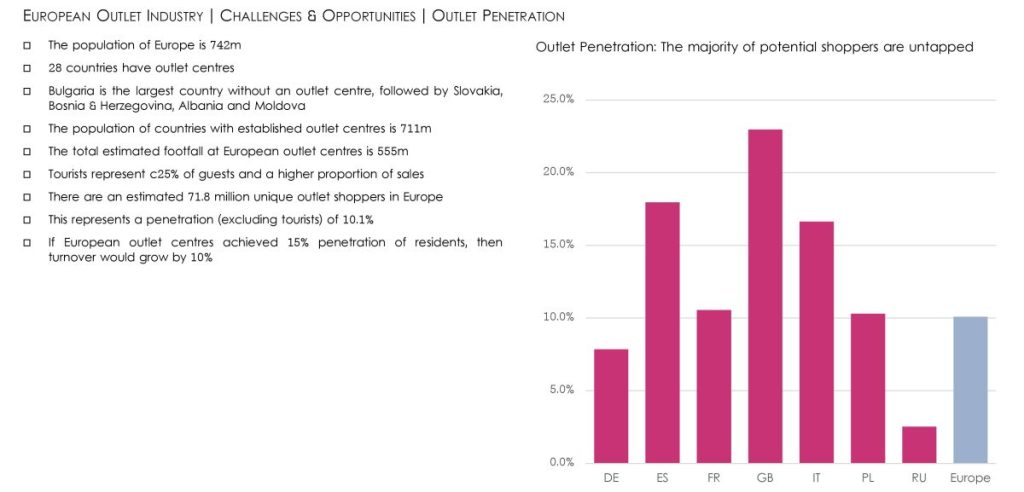
His analysis suggests that only around 10% of Europe’s population are outlet shoppers. Based on an estimated 71.8 million individual outlet shoppers across a population of 711 million in countries with established outlet centers, the current penetration rate is approximately 10.1%, excluding tourists.
In other words, almost 90% of the potential domestic customer base remains untapped.
“Almost 90% of Europe’s population are not outlet shoppers. That represents an enormous untapped opportunity.”
Ken Gunn
Gunn sees this as one of the industry’s most significant growth opportunities. If European outlet centers could increase domestic penetration to 15%, he estimates that overall turnover could grow by approximately 10%.
The differences between individual markets are considerable. The UK, Spain, and Italy already demonstrate relatively strong outlet penetration, while Germany, France, and Poland have considerable room for improvement.
This raises an important strategic question: Are outlet operators doing enough to attract people who do not currently consider outlet shopping relevant to their lifestyles?
Gunn argues that the industry may have become too focused on its existing customers and on delivering ever-better retail environments for them. While quality, brand selection, and experience remain essential, the next generation of customers may require a different proposition.
A generational shift requires a different approach
The transition from Generation X to Millennials and Generation Z is changing how people discover, evaluate, and purchase products.
Younger consumers are digitally native. Social media, influencers, peer recommendations, and online research play an increasingly important role in their purchasing decisions. They also place greater emphasis on sustainability, experiences, and the integration of physical and digital shopping.
For Gunn, one of the industry’s risks is that many of the people making strategic decisions in outlet real estate belong to Generation X, while their customers increasingly belong to younger generations.
Are operators sufficiently close to understanding what these consumers actually want?
The implications extend beyond marketing. They affect merchandising, tenant selection, customer services, and the overall positioning of outlet destinations.
“When outlet destinations start looking the same, consumers have fewer reasons to visit different centers.”
Ken Gunn
Gunn also points to changes in the composition of outlet retail. Clothing and footwear continue to dominate, but their share has gradually declined. Food and beverage, leisure, personal care, and other supporting categories have become more important.
Fashion itself is changing. The classic fashion segment is losing ground, while the more accessible, family-oriented, and assured segments are gaining importance.
The traditional outlet proposition of branded products at attractive discounts therefore needs to evolve. Consumers still want value, but they increasingly expect that value to be combined with convenience, relevance, and a compelling overall experience.
Digital extension of the outlet experience
Digital commerce represents another opportunity that Gunn believes the industry has not fully explored.
Online shopping services have been available in the outlet sector for more than a decade, but their development accelerated during the pandemic. According to his research, seven outlet destinations currently offer online shopping, involving approximately 243 stores and 191 brands.
Interestingly, the participating digital brands have an average brand quality rating of 4.7, higher than the average of the physical stores represented at these destinations.
Gunn argues that online shopping should not be viewed as an alternative to visiting an outlet center. For digitally native consumers, it is increasingly an extension of the physical experience.
“Online shopping should not be seen as an alternative to the physical outlet experience, but as its extension.”
Ken Gunn
The potential benefits go beyond online sales. Digital platforms can increase brand awareness, generate additional footfall through click-and-collect services, attract customers from more distant catchment areas, and encourage online shoppers to visit physical stores for the first time.
There is also an economic argument. Gunn identifies the possibility of up to 30% more sales at participating brands and estimates that a mature digital proposition could increase sales at individual outlet sites by 20% to 25%. Across the European outlet industry, he sees the potential for digital sales to reach €3.6 billion.
These are ambitious projections rather than established market results, but they illustrate the scale of the opportunity.
The underlying message is that outlet operators should not simply replicate conventional e-commerce platforms. They need to create digital services that reinforce the strengths of physical outlet destinations: attractive brands, compelling offers, convenience, and discovery.
The Digital Opportunity
| Outlet destinations offering online shopping | 7 |
| Participating stores | 243 |
| Participating brands | 191 |
| Estimated potential digital sales | €3.6bn |
| Potential sales uplift at mature sites | 20-25% |
Benefits of Digital Services
- Click & Collect
- New customer acquisition
- Extended catchment areas
- Digital promotions
- Additional brand awareness
- Sales outside normal trading hours
Development opportunities remain
Despite the widespread perception that Europe is already saturated with outlet centers, Gunn challenges the assumption that the market has reached its development limits.
His analysis identifies potential demand for the equivalent of almost 50 additional outlet centers, or approximately one million sqm of retail space, beyond the current development pipeline.
The opportunity, however, is not necessarily to replicate the large international destinations developed by the sector’s pioneers.
McArthurGlen and Value Retail traditionally targeted locations with exceptionally strong catchments, typically combining approximately 10 million residents, 10 million domestic tourists, and eight million international visitors within a 90-minute drive.
After three decades of expansion, relatively few comparable locations remain available.
Other operators, however, can pursue different opportunities. Smaller markets, regional destinations, second-tier cities, and locations with a stronger domestic tourism component can support alternative outlet formats.
Gunn highlights the potential for more flexible concepts, including urban outlet centers and schemes integrated into mixed-use destinations or existing retail parks.
He also sees considerable opportunities in Central Europe, particularly in Germany, as well as in markets where outlet retail has yet to reach its full potential.
The current development pipeline, however, does not fully reflect these opportunities.
New outlet developments and extensions scheduled through 2029 represent approximately 384,000 sqm of potential additional floorspace. New centers account for 64% of this pipeline, while the remainder comprises extensions to established assets.
Development activity is concentrated in a relatively small number of countries, particularly Germany, the UK, and Italy. At the same time, high construction and financing costs, combined with more cautious investors, are making opening dates increasingly uncertain.
Gunn’s argument is that the industry needs to become more creative about where and how it develops. The question is not simply how many new outlet centers Europe can accommodate, but which formats are appropriate for which markets.
Europe’s Largest Outlet Destinations
Serravalle Designer Outlet, Italy

Located in Serravalle Scrivia, between Milan and Genoa, Serravalle Designer Outlet is Europe’s largest single-site designer outlet destination.
Operated by McArthurGlen, it offers more than 230 designer brands, including Gucci, Prada, Dolce & Gabbana, Nike, Polo Ralph Lauren, and Michael Kors.
Outletcity Metzingen, Germany

Outletcity Metzingen is Europe’s largest outlet destination by sales area. Unlike a conventional enclosed outlet mall, it is an integrated retail district spread across the town of Metzingen, approximately 30 minutes south of Stuttgart. It features more than 130 stores representing over 170 premium and luxury brands, including Gucci, Prada, Nike, Tommy Hilfiger, and the world’s largest BOSS outlet.
Investment remains the decisive factor
Despite his critical assessment of the current market, Gunn remains optimistic about the long-term prospects of the European outlet industry.
The sector continues to benefit from several structural advantages. Brands need additional channels to generate turnover, consumers remain attracted by recognizable brands and compelling value, and investors are looking for assets capable of delivering attractive income growth.
Outlet operators have also demonstrated considerable adaptability. They can reposition their assets, adjust their merchandising, introduce new services, and respond to changing consumer expectations.
However, performance increasingly depends on the quality of execution and the willingness to invest.
Gunn’s latest assessment demonstrates that centers receiving targeted investment are continuing to improve their competitive position. VIA Outlets, for example, had six assets among the 30 most improved centers in his 2026 ranking. Vila do Conde, Landquart, and Batavia were among the group’s notable performers.
The broader message is clear: the next phase of outlet development will not be driven by expansion alone, nor will it be enough to rely on the industry’s established formula.
The winners will be those who understand their customers, differentiate their retail offer, embrace digital opportunities, and invest in assets that are capable of evolving.
The European outlet industry is far from reaching its limits. But its next chapter will be defined less by the number of stores it adds and more by how intelligently it uses the opportunities that remain.