It is a typical Saturday morning in a European city. The sky is grey and the first coffee of the day hasn’t quite taken effect yet. For the Weber family – Thomas (42, architect), Julia (39, teacher) and their children Mia (10) and Leon (6) – the weekend traditionally begins with a logistical marathon. The family’s to-do list on the fridge is long: the weekly shop for four, an urgently awaited parcel to collect, a jar of loose change to take to the bank, a prescription that has been sitting in a jacket pocket for days – and Thomas is really overdue for a haircut. Normally, completing this list would involve traveling between five different locations across the city, searching for parking at every stop, dealing with increasingly impatient children in the back seat, and sacrificing a significant portion of the weekend – a real test of patience for the whole family.

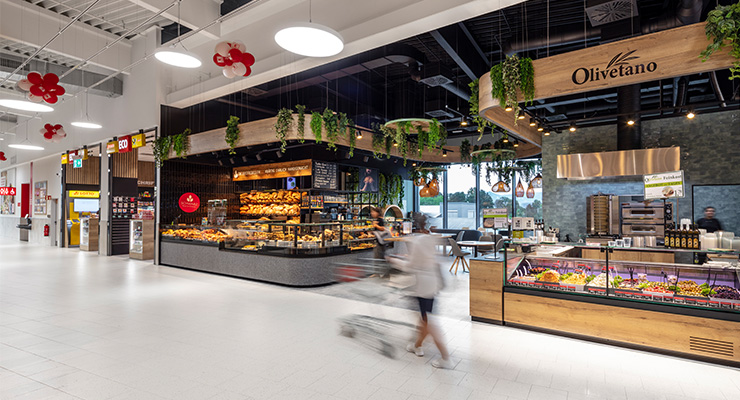
Today, however, things look far more relaxed for the Webers. The family gets into the car and heads for a single destination: their local Kaufland store. Here, within approximately 3,500 square metres of retail space, they find everything under one roof. A bakery and patisserie, a snack bar, a newsagent selling tobacco, lottery tickets and newspapers, a hairdresser, a pharmacy, a sushi shop-in-shop and a range of customer-focused vending solutions, all operating as tenants, complement the core food retail offer.
After parking, they open the Kaufland Xtra app and collect a trolley. While Julia visits the pharmacy before starting the weekly grocery shop, Thomas collects a parcel from the newsagent. He then deposits his loose change in a Coinstar machine and receives a shopping voucher in return.
Leon is immediately drawn to a children’s vending machine featuring collectible puppy figures, while Mia is fascinated by the adjacent Mystery Pack machine. For a small fee, customers can purchase unopened parcels returned to online retailers, creating an element of surprise and discovery. After a little persuasion, Thomas agrees, and father and daughter each select a mystery package. What would otherwise be a waiting period becomes a small but memorable experience.
Convenience beyond the grocery aisle
Shortly afterwards, Thomas is enjoying a walk-in haircut while Julia not only picks up medication but also takes advantage of a professional skin analysis service available within the pharmacy.
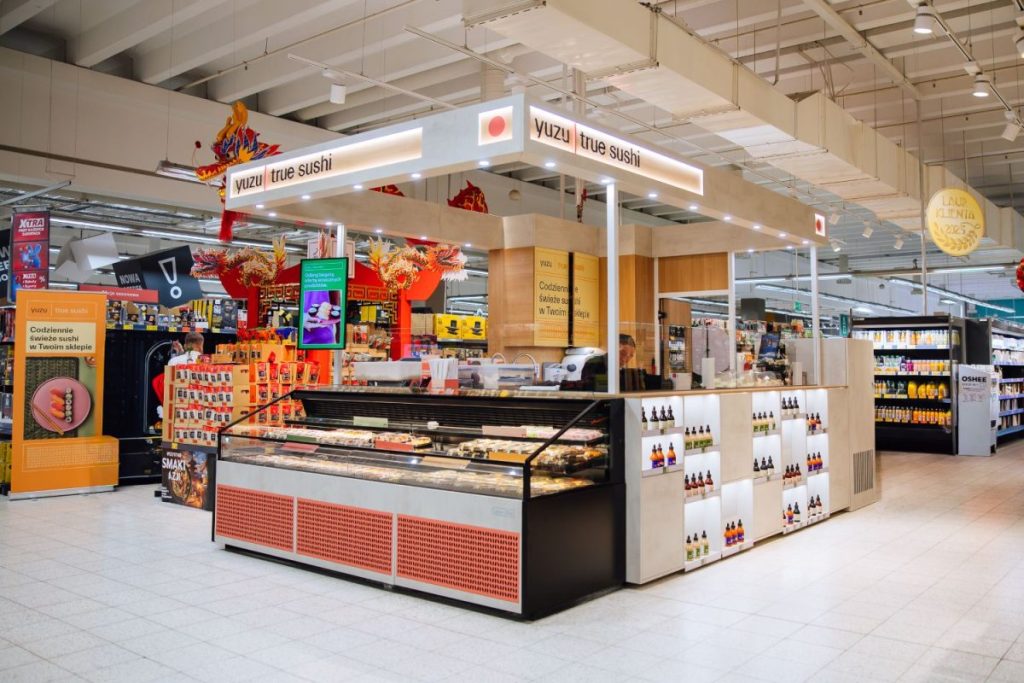
As they shop at Kaufland, they scan their products directly at the shelf using a handheld scanner linked to their Kaufland Card. It streamlines the checkout process and entertains the children too. Their route takes them past fresh fruit and vegetables and the sushi shop-in-shop island, where the family picks up lunch. From there it’s on past the service counters and through the drinks aisle to the frozen food just before the checkouts.
After paying, Thomas notices a green GREENMNKY® machine, which precisely applies new screen protectors to phone displays. Since his is cracked, he decides to try it. Less than 100 seconds later, his smartphone is protected again and looks as good as new. Job done!
“A strong grocery anchor reliably attracts thousands of customers every week.”
For the Weber family, this morning is about far more than completing errands. They have reclaimed valuable time together as a family. What appears to be effortless convenience is, in reality, the result of a carefully orchestrated retail concept: one-stop shopping by Kaufland’s leasing division. For developers, investors and centre managers, this scenario highlights the key currencies of physical retail: footfall, dwell time and customer relevance. The customer journey is consolidated from a fragmented series of errands into a high-footfall hub, streamlining the shopping experience and reducing consumer friction.
Orchestrating a connected ecosystem like this profitably requires far more than good ideas. What feels like a coincidence to the Webers is in fact built on a carefully integrated hypermarket and leasing concept.
Beyond the traditional grocery model
Kaufland has long since evolved beyond the role of a traditional food retailer. Today, the company operates as both a property developer and a landlord. The philosophy behind this is compelling for any retail professional: A strong grocery anchor such as a Kaufland hypermarket reliably attracts thousands of customers every week. This guaranteed footfall is systematically leveraged to create a wider ecosystem of services, food operators and, where appropriate, specialist retail tenants. The result is a mutually beneficial model in which complementary offerings increase the supermarket’s attractiveness, while tenants gain access to consistent customer footfall and can grow their businesses without investing heavily in location-specific marketing.
The scale of this asset management operation speaks for itself and underlines its economic significance. Kaufland’s leasing division currently manages around 1.5 million sq m of lettable space. This comprises some 13,000 individual units operated by approximately 5,300 partner businesses. For investors and developers, the model offers two particularly attractive characteristics: scalability and local adaptability. An average Kaufland location hosts around eight concession operators occupying approximately 400 sq m of space. At larger sites, specialist retail operators can be integrated, with some locations providing more than 1,000 sq m of additional leasable area. This flexibility shows how the concept can be adapted to local market conditions, catchment characteristics and urban density.
At the same time, the traditional pre-checkout zone is undergoing rapid transformation as consumer expectations continue to evolve. Established retail categories are adapting to remain relevant and maintain their space productivity. The traditional newsagent is a good example. Increasingly, these businesses are expanding their role through parcel collection, financial services, and additional convenience offerings, creating multifunctional service hubs rather than simple points of sale for newspapers and tobacco products.
“Retail property is not only about space productivity or the mathematically perfect tenant mix.”
Traditional bakers and butchers are transforming their offer too, with a clear trend towards convenience food. Consumer demand is shifting towards high-quality options to eat on the spot or for an easy dinner, encouraging operators to introduce hospitality-led concepts that offer a more engaging customer experience. Customer relevance and flexibility have become critical success factors for leasing, and for developers, they are also the key to future-proofing existing retail assets over the long term.
However, flexibility alone is not enough. To maximize returns per square meter, physical retail environments need intelligent spatial concepts. To counterbalance purely online competitors, physical space must offer experiences and services that simply cannot be replicated online. To this end, Kaufland is implementing initiatives that transform the traditional leasing model of a shopping centre into a modern service hub.
Technology as a new enabler
A key driver of this evolution is the growing digitalization and automation of retail space. Self-ordering systems and digital order terminals cut waiting times and make ordering far more efficient. At the same time, streamlined processes allow staff to focus fully on their core business. A welcome side effect is a higher average transaction value. This is driven by targeted cross-selling and by multilingual menus that break down language barriers. Some foodservice operators are already trialling robotics within their kitchens, enabling higher customer volumes to be served efficiently even from smaller footprints and thus tackling the industry-wide staff shortage effectively.
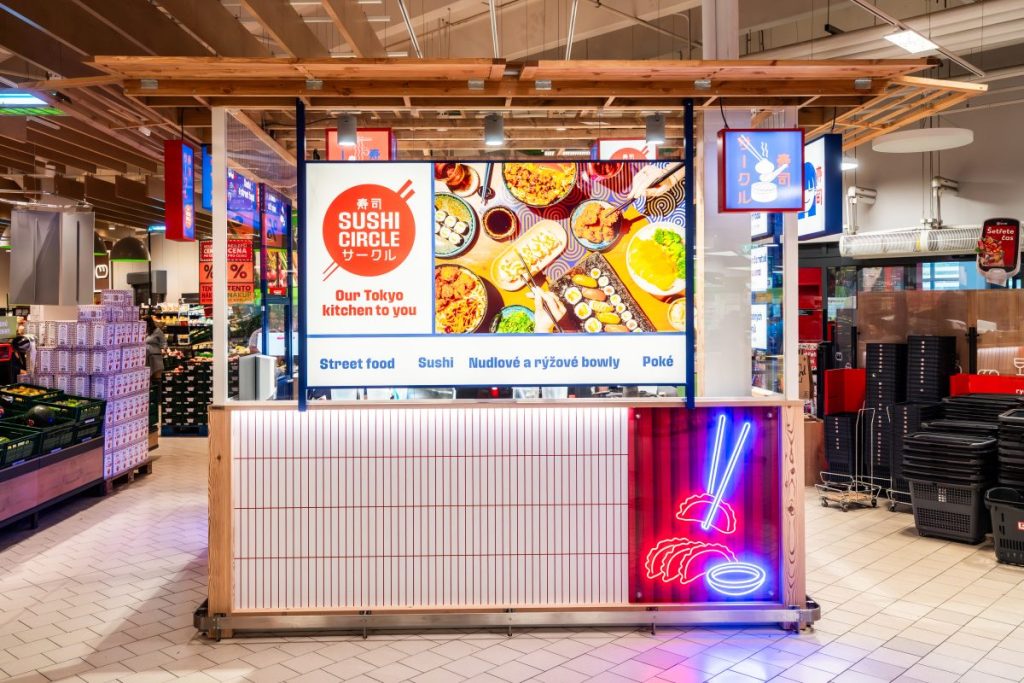
The symbiotic relationship between retail and services becomes particularly evident when tenants are integrated into the sales floor as part of a unified retail concept rather than being treated as separate offerings. Here, Kaufland is setting new industry benchmarks with strong strategic partnerships. Shop-in-shop concepts, such as those with sushi partners, have proved a resounding success. Customers can watch their sushi being freshly prepared in front of them. This conveys craftsmanship and exceptional freshness right at the point of sale and offers the customer clear added value.
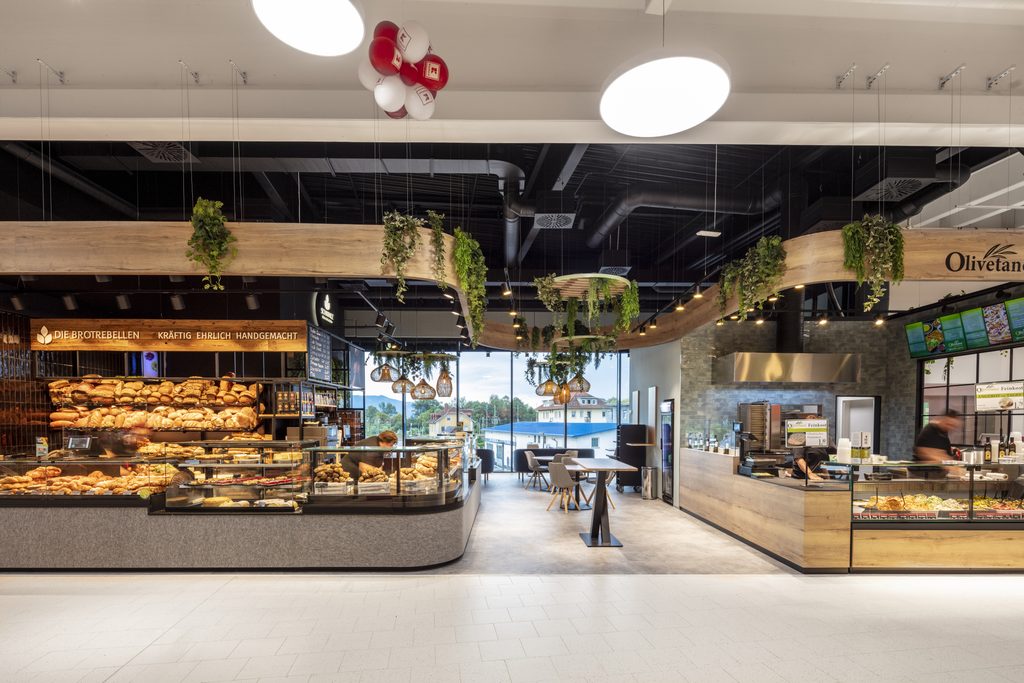
In cooperation with other partners, Kaufland goes a step further with its ‘Fresh Kitchen’ counters, which are being introduced in the fruit and vegetable departments. Here, fruit and vegetable snacks are prepared fresh daily on-site, from colorful fruit platters and crisp salads to fitness bowls. The portfolio is further complemented by partnerships with well-known brands. These bring premium urban convenience food into an established retail setting and specifically attract younger target groups.
Development of these locations extends well beyond food retail to include specialist retail space. Together with international partners, Kaufland is trialling innovative concepts, from large-format furniture and electronics stores to specialist bicycle retailers. Carefully combining complementary ranges and services creates cross-selling synergy par excellence. It results in high customer volumes for both parties and reduces customer acquisition costs over the long term. Through partnerships like these, the traditional sales floor becomes a high-footfall experiential destination. Retailer and partner benefit alike, and the entire retail location is strengthened. The health sector is another major growth driver that extends far beyond the mere purchase of goods.
“One-stop shopping evolves from an idea into a scalable business model for bricks-and-mortar retail in a digital world.”
Health is increasingly seen as a core component of neighborhood retail services. In Slovakia and the Czech Republic, for example, innovative prevention centers operated within pharmacy chains have already been integrated, offering quick health checks during the weekly shop.
Making use of every space
Alongside the major anchor tenants, Kaufland consistently makes use of all available space with smart service solutions. The open-network myflexbox parcel lockers solve the returns problem for customers and delivery services alike. Especially entertaining – and value-creating – is the gamification of shopping in the form of the Mystery Pack machine. For between €10 and €15, customers can buy unopened e-commerce return parcels. Anything from high-quality socks to a smartwatch could be inside. It’s a fun way to spark curiosity and get people talking at the dinner table. At the same time, it turns transit zones into profitable transaction spaces.
Back to the Weber family. The car is packed with fresh groceries for the week ahead, but they have achieved far more than that. The boxes of freshly prepared sushi for a shared lunch sit atop their shopping bags. Thomas runs a hand through his freshly cut hair. The coin voucher has been credited against the till receipt, and the parcel has been collected. In the back, Mia and Leon are excitedly unpacking their purchases from the Mystery Pack and the toy vending machines. In the passenger seat, Julia sits back, knowing there was no stressful search for parking and no frantic dash from shop to shop in uncertain weather. It’s a much more relaxed start to a well-earned weekend, and the rest of Saturday belongs entirely to the family. What was once an exhausting chore has become a comfortable, far more enjoyable experience.
This is where Kaufland’s real estate strategy comes full circle. For retail and property professionals, the scenario sends a clear, unambiguous message. Development and leasing are not only about space productivity or the mathematically perfect tenant mix. They are about customers’ real lives. Kaufland has understood that time given back is one of the most valuable commodities in today’s fast-paced society. Retail property that respects and protects that time will continue to outperform.
Kaufland has long been more than just a supermarket. It is a hybrid ecosystem designed around contemporary consumer needs, today and in the future. Through innovative leasing concepts, automation, strategic partnerships, and continuous development of its core business and product range, the company is creating future-proof retail destinations that strengthen customer loyalty. This takes grocery-led retail to a new level and secures stable returns for developers, investors and retailers alike. One-stop shopping thus evolves from an idea into a scalable business model that keeps bricks-and-mortar retail indispensable in a digital world.