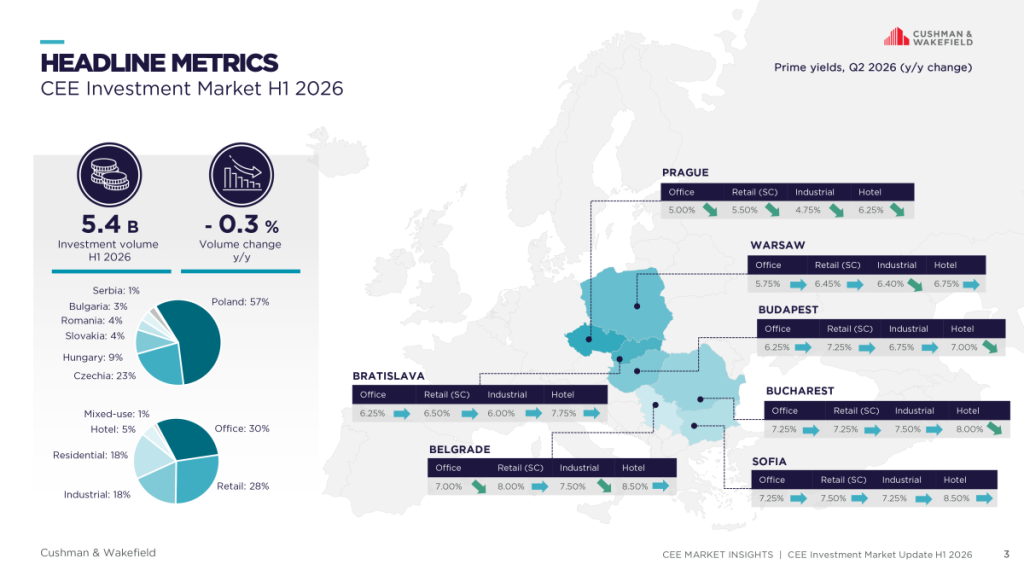
Retail has regained momentum in the CEE investment market. According to Cushman & Wakefield’s CEE Investment Market Update H1 2026, retail accounted for 28% of total regional investment in the first half of the year, up from 24% for full-year 2025.
The increase was driven overwhelmingly by the landmark acquisition of a 70% stake in the Polish Galeria Posnania by the Czech real estate fund Trigea for €370 million in June 2026, as well as the return of large-format retail transactions in Hungary. The Cushman & Wakefield report identifies the Posnania transaction as the key driver behind Poland’s strong Q2 retail investment volume.
Poland Drives The Recovery
Poland was by far the largest retail investment market in the region. Total real estate investment reached €3.1 billion in H1 2026, up 80.4% year on year, with retail accounting for 34% of the country’s investment volume. Posnania was the largest retail transaction listed in the report, alongside the acquisition of an Auchan portfolio.
In March 2026, the Hungarian investment group Shopper Park Plus Plc closed the acquisition of an eight-asset retail portfolio in Poland from Auchan Polska and Ceetrus for €155 million. The portfolio comprises approximately 208,000 sqm of GLA across eight food-anchored retail schemes.
Overall, Poland recorded its strongest first half since 2018, with larger transactions and growing portfolio activity contributing to the increase. Average deal size rose to approximately €45.7 million from €22.6 million a year earlier, while portfolio transactions accounted for 42% of Polish investment volume, compared with 14% in H1 2025.
The underlying retail market is also showing considerable activity. CEE-6 shopping center stock stood at approximately 19.6 million square meters at the end of Q2, while retail parks accounted for another 10.3 million square meters. Retail parks are currently driving new supply, with around 940,000 square meters under construction. Total retail space under construction reached 1.29 million square meters, 15% more than a year earlier.
Poland illustrates the shift particularly clearly. The country recorded its strongest quarter for retail deliveries since 2019, with approximately 150,000 square meters completed in Q2, up from around 90,000 square meters in the previous quarter. Another 650,000 square meters is in the pipeline, 90% of it in retail parks. Nine international brands entered the Polish market during the first half of the year.
Retail Supply Keeps Moving
Other markets are developing along different lines. The Czech Republic attracted 16 new international brands in H1, led by food and beverage, while approximately 146,800 square meters of retail space is in the pipeline. In Hungary, shopping center stock remained broadly unchanged as development restrictions continued to limit new supply, while retail parks expanded.
At the same time, Budapest’s Fashion Street rents increased 14.3% year on year and shopping center rents rose 5.3%. Bulgaria also recorded strong retail activity, with completed retail space up 47% year on year, 82 store openings and prime Sofia shopping center rents reaching €48.50 per square meter.
Hungary’s investment market provides another indication of the changing retail landscape. Total investment reached €495 million in H1, up 42.6% year on year, with retail accounting for 41% of the country’s investment volume. Retail overtook office as Hungary’s leading investment sector in the first half of the year.
The acquisition of Árkád Szeged by the Hungarian real estate fund HOME Ingatlanfejlesztő Alap from ECE European Prime Shopping Centre Fund II on March 19, 2026, represented Hungary’s first large-scale shopping center transaction since 2019.
Pricing Remains Largely Stable
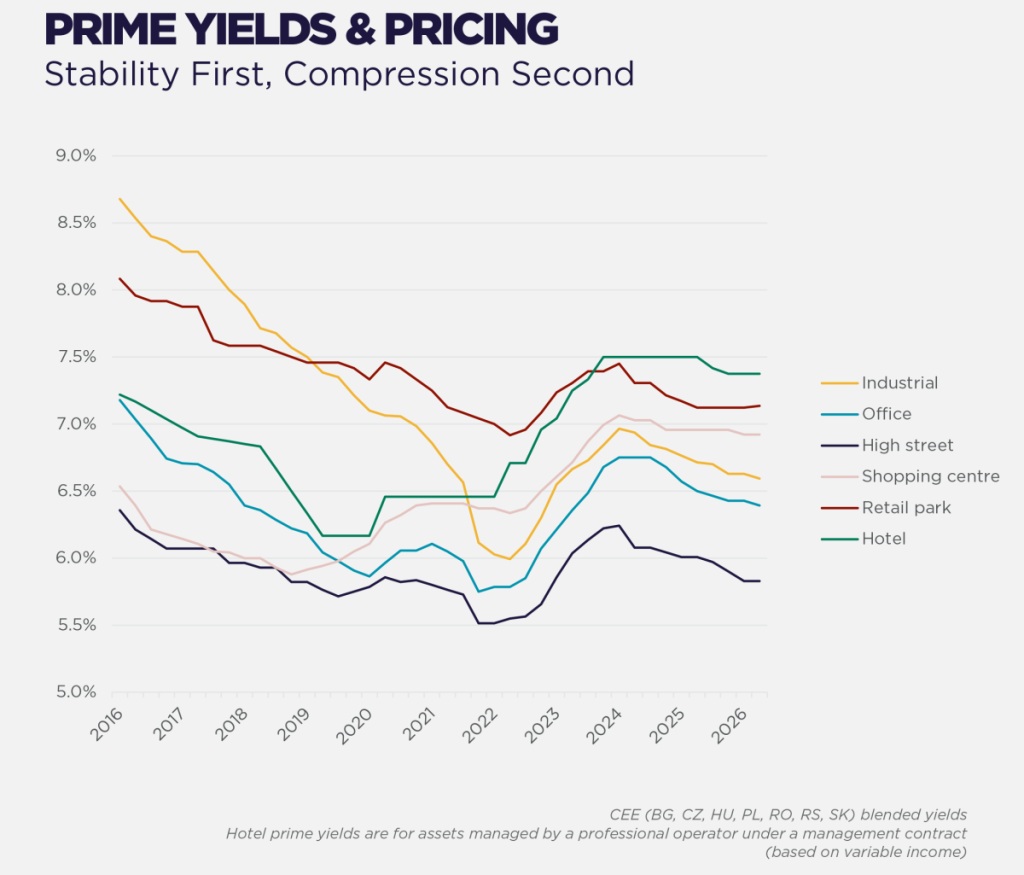
The renewed investment activity has not, however, resulted in a broad repricing of retail assets. Prime yields across CEE remained largely stable during H1 2026, consistent with the pricing equilibrium established during 2025.
The Czech Republic recorded a 25-basis-point compression in prime shopping center yields, while Serbia saw a 50-basis-point compression in high-street retail, although Cushman & Wakefield cautions that the Serbian figure is based on a very thin transaction base. Czech retail parks were the only retail segment in the region to see yields move outward, by 10 basis points. All other country and sector combinations were unchanged from Q2 2025.
The country data also underline how uneven the recovery remains. Retail accounted for 32% of investment in Romania despite the country’s overall investment volume falling 46% year on year. Serbia’s retail share reached 37%, although from a very small total market of €47 million. Slovakia‘s retail share was only 5%, while the Czech Republic recorded 11%.
More retail transactions could follow in the second half of the year. In Romania, a retail portfolio transaction forms part of a combined pipeline of approximately €530 million in transactions expected to close by year-end. Bulgaria has a cross-border retail transaction worth around €122 million awaiting regulatory approval, while Poland’s pipeline includes further retail deals.
For retail real estate, the first half of 2026 therefore brought a combination of stronger investment activity, expanding retail park supply and relatively stable pricing. The Posnania transaction has had a major impact on the regional numbers, but the wider data point to renewed investment activity across several retail markets, including Hungary and Poland’s increasingly active retail park segment.
For more information please refer to the Cushman & Wakefield, CEE Investment Market Update H1 2026.