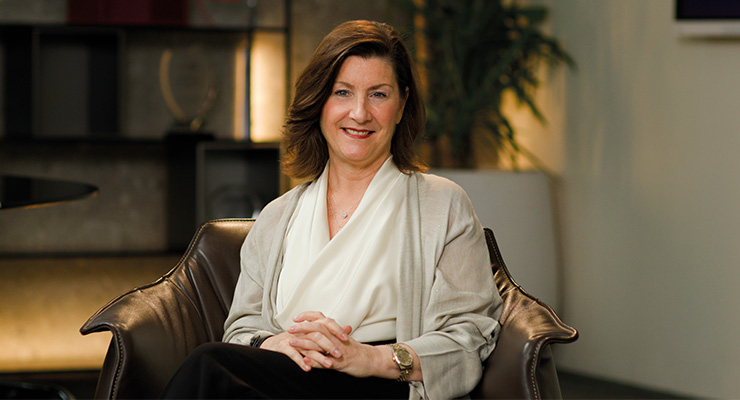
There is a particular sentence that says a great deal about Alison Rehill-Erguven’s approach to retail real estate: “You can’t ‘value-engineer’ your way to relevance.”

It comes from a recent conversation about the challenge of managing rising operational costs without compromising the customer experience. But it could just as easily serve as a description of her broader philosophy.
Relevance, for Rehill-Erguven, is not a question of size or scale. It comes from understanding people, knowing the market, paying attention to culture and being willing to change. It is an approach that has followed her through almost three decades in the industry and across Asia, Europe, Latin America, the United States and, most recently, Saudi Arabia.
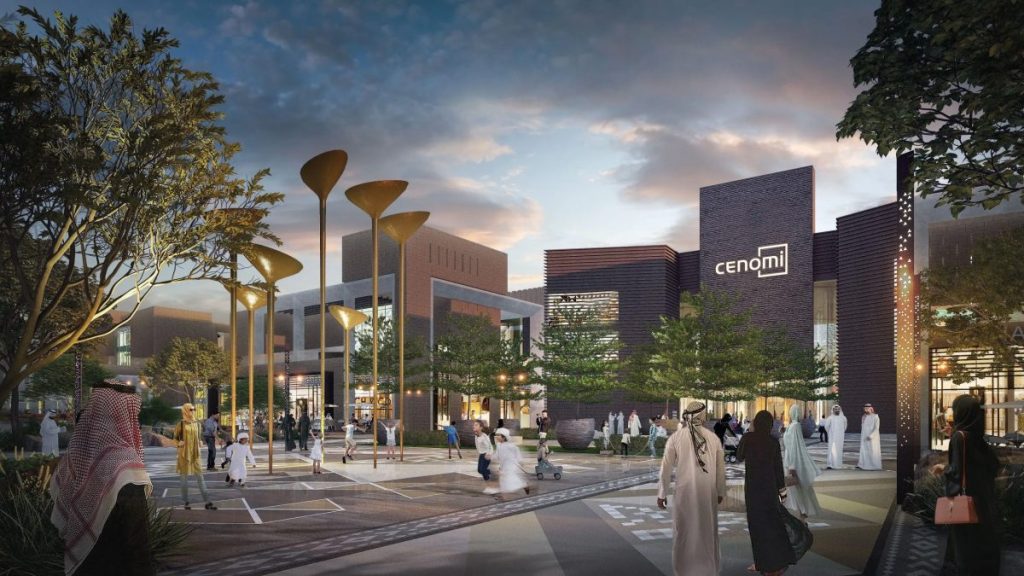
Since 2022, she has been CEO of Cenomi Centers, the Kingdom’s largest shopping center developer, owner and operator. The company manages a portfolio of 21 assets across nine Saudi cities, representing around 1.4 million square meters of gross leasable area. But the numbers alone say little about the challenge she took on when she moved to Riyadh.
“You can‘t value engineer your way to relevance.”
Saudi Arabia is in the middle of a profound transformation. Vision 2030 is changing the country‘s economy, urban landscape and consumer environment. Retail and retail real estate are not simply benefiting from that transformation. It is part of it.
For Rehill-Erguven, that makes Saudi Arabia an unusually compelling place to be right now. “I am such a strong believer in education,” she said at the Forbes Middle East Women’s Summit. “We’re never too old to learn.” Travel and the exploration of new cultures, she has said elsewhere, have been central to her own career development. They also explain something about the way she approaches markets: curiosity comes before prescription.
ALISON REHILL-ERGUVEN – A Career in Retail Real Estate
| 2022–present: Cenomi Centers, Riyadh. CEO. Leads Saudi Arabia‘s largest shopping center developer, owner and operator, with a portfolio of 21 assets across nine cities. |
| 2021–2022: Brookfield Properties, Shanghai. Acting Head of Commercial Real Estate / Senior Advisor. Led an acquisition transition and merger involving a multi-billion-dollar retail, office and mixed-use portfolio. |
| 2016–2022: Pradera Retail Asia, Shanghai. CEO and Board Director / Chairwoman. Led a team of more than 160 professionals across China and Turkey and oversaw the development and refurbishment of more than 1.5 million sq. ft. of assets valued at more than USD 2 billion. |
| 2010–2017: Pradera, Istanbul. Managing Director and Board Director. Led cross-border teams and repositioning and asset-enhancement initiatives across Turkey and CEE. |
| 2006–2010: General Growth Properties, Chicago. Vice President, International Asset Management. Managed the performance of 15 assets in Brazil and Turkey with a combined value of approximately USD 400 million. |
| 2003–2006: General Growth Properties, Chicago. Vice President, Business Development, leading the national accounts leasing division. |
| Board roles: Non-Executive Director, ESAS Gayrimenkul / Properties, Turkey, since 2016. Previous executive board roles include Pradera and several international retail real estate joint ventures. Held advisory board roles for ICSC Europe and Asia from 2014-2019. |
A career built across markets
Rehill-Erguven’s career did not develop along a single geographical or corporate path. Her first expat assignment was at the age of 24 in Istanbul, Turkey. She was then in fashion and working at a fashion college, LaSalle College, which is the fashion school of McGill University. When she returned to the United States after 3.5 years, she switched industries and found retail real estate, first with Simon Property Group and then with GGP. It was her time at GGP that led her back into an international career in retail real estate, and increasingly senior positions took her to Turkey, Brazil, China and other markets.
At General Growth Properties, she held international asset management and business development roles and was involved with joint ventures in Brazil and Turkey. As Vice President of International Asset Management, she oversaw the performance of 15 centers representing approximately $400 million in assets. She also served on the boards of both JVs.
In 2010, she moved to Pradera, where she became Managing Director and a Board Director. Based in Istanbul, she led cross-border teams and worked on repositioning and asset enhancement initiatives while also taking responsibility for sustainability initiatives and operations across Turkey and Central and Eastern Europe.
Her next major move took her to China. As CEO of Pradera Retail Asia and Chairwoman (PRA was a JV with MIRA – Macquarie Bank), she led a team of more than 160 professionals across China and Turkey and oversaw the development and refurbishment of more than 1.5 million square feet of assets valued at more than $2 billion. The business was subsequently acquired by Brookfield Asset Management in 2021.
She then joined Brookfield Properties as Senior Advisor in Shanghai, where she led the acquisition transition and merger involving a multi-billion-dollar portfolio spanning retail, office and mixed-use assets while still holding her executive and board position with Pradera and overseeing the Turkish business. During her time with Brookfield she also took on the role of Head of Commercial Real Estate, China.
By the time she arrived in Saudi Arabia, international complexity was hardly new to her. What was new was the scale and speed of the transformation taking place around her.
Rehill-Erguven‘s international experience has given her a particular perspective on one of the central questions facing global retail today: how much can be transferred from one market to another?
Her answer is clear. The fundamentals may travel. The consumer does not.
Learning a market rather than importing one
At the 2026 RLC Fashion Summit, she pointed to her experience in China when explaining what international brands need to understand about Saudi Arabia. “The global playbook is fine,” she said. “It’s the brand equity. It’s the brand identity, but they must tap into the local culture.”
That means understanding the local art, design, music and influencer scenes, as well as the occasions and cultural moments that matter to consumers. It is not simply a matter of translating an international concept into another language or market.
The same principle applies to shopping centers. At the Forbes Middle East Women’s Summit, Rehill-Erguven described one universal truth she has observed across the markets in which she has worked: women make the majority of purchasing decisions in a household. But she immediately added another point. “Everybody’s different and every culture is different.”
“Strong governance, disciplined asset management, operational excellence and customer insight are relevant in every market.”
From shopping to time well spent
For her, customer understanding starts with research: how people shop, why they shop, when they shop and what they shop for. Only then does the work of designing the destination begin.
That can have very practical consequences. Rehill-Erguven has spoken about everything from tenant mix and food to personal shopping, baby-changing facilities and parking for pregnant women. Customer-centricity, in her view, is not a slogan. It is expressed in hundreds of decisions that determine whether a destination is genuinely convenient and relevant.
That thinking is particularly important in Saudi Arabia, where the role of the shopping center is evolving rapidly. “The shift is from ‘shopping trip’ to ‘time well spent,’” Rehill-Erguven has said.
It is a simple phrase, but it captures a broader transformation in retail real estate. A mall increasingly has to compete not only with another mall, but with every other way consumers can spend their time.
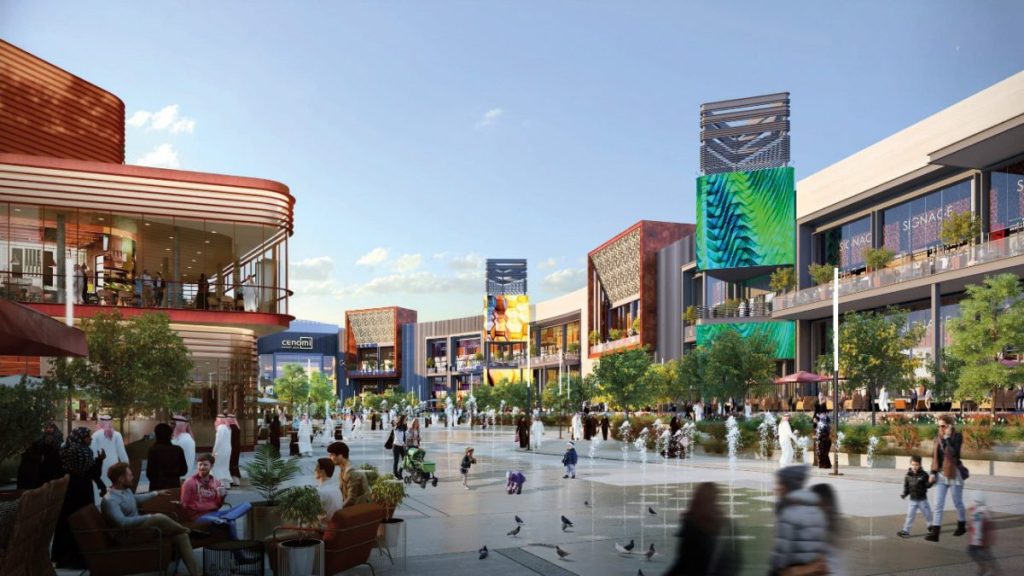
That means food, entertainment, services, wellness, culture and social interaction become part of the proposition. It also changes the role of the operator. Leasing space is no longer enough. The mix has to be curated and continually recalibrated.
“The goal is an ecosystem,” she said. “When the destination is compelling, brands perform better; when the offer is curated, the destination gets stronger.” This is perhaps where the distinction between scale and relevance becomes most apparent.
“Don’t be afraid to fail.”
Saudi Arabia is seeing major investment in new destinations, infrastructure, tourism and entertainment. In such an environment, the temptation could be to measure progress in square meters, new brands or headline projects.
Rehill-Erguven tends to look at something else: whether people actually choose to be there. She describes the emergence of a “destination weekend” mindset, in which shopping centers can become part of how people plan their time. The opportunity, she says, is to build assets that people choose, rather than places they simply default to.
Leading from the front
There is another dimension to Rehill-Erguven’s leadership that goes beyond the physical destination: the organization behind it. She is openly skeptical of silos. “I do not like silos and I break down walls,” she said in her Forbes interview. “And if I have to, I’ll force-feed collaboration.”
When she arrived in Saudi Arabia, she found an organization in which silos had developed. Changing that culture, she says, took time. But collaboration became a deliberate leadership priority.
The same applies to diversity and female talent. When she arrived at Cenomi, women represented less than 30% of the workforce, according to her account. That figure has since risen to close to 35%, while she has also pushed for at least half of the company‘s new graduate intake to be female.
But her argument goes beyond numbers. She talks about providing women with practical tools for leadership: education, emotional intelligence, public speaking and conflict resolution. She also emphasizes mentoring, executive coaching and networks as important in her own development.
And then there is confidence. “I think confidence cannot be overrated,” she said. “We deserve a seat at the table.”
There is nothing particularly complicated about the statement. Its importance lies in the fact that she applies it not only to herself but to the people she wants to develop around her.
Empathy is not weakness
For all the emphasis on transformation, growth and performance, one of the more revealing aspects of Rehill-Erguven’s leadership philosophy is her emphasis on empathy.
“Females have a tendency to be more empathetic and more kind,” she said. “No matter where I’ve lived, I’ve always tried to lead with some empathy and some kindness and courage.”
She is careful not to frame empathy as an alternative to performance. Quite the opposite. Her argument is that an environment in which people feel safe to contribute, experiment and fail is more likely to generate innovation: “Once you create an empathetic environment where people feel safe, then you get more innovation. You get more creativity. You’ll get more leadership.”
There is a consistency here with her attitude toward markets. Whether the subject is a consumer, an employee or a country, understanding comes before action.
And failure, in her formulation, is not the opposite of progress. “Don’t be afraid to fail,” she said. “They pick themselves up and keep going.”
It is an unusually direct philosophy for an industry in which the language of transformation can sometimes become abstract.
The Saudi moment
The timing of Rehill-Erguven’s arrival in Saudi Arabia is clearly part of the story. Cenomi Centers sits at the intersection of retail, real estate, tourism, entertainment and urban development. Vision 2030 is creating new demand and expectations.
Rehill-Erguven sees retail real estate as unusually well positioned to contribute to that transformation. “I don’t think any other industries besides retail and retail real estate fits those three [Vision 2030] pillars better,” she said in Milan, referring to the ambition of building a vibrant society, diversifying the economy and improving quality of life.
“Everybody’s different and every culture is different.”
But again, she brings the discussion back to execution: “I think Saudi is living up to its Vision 2030 vision with execution, which is the key.”
Rehill-Erguven has spent much of her career operating at the point where strategy has to become physical reality. Repositioning an asset, integrating an acquisition, managing a joint venture, developing a team or changing a customer proposition all require execution.
In Saudi Arabia, she is doing so against the backdrop of a market moving at exceptional speed. Her challenge is not simply to grow Cenomi. It is to make its destinations relevant to a consumer base whose expectations are changing just as quickly.
Meeting the local market
Rehill-Erguven brings an unusually international perspective to a market that is developing its own identity. Her experience in Asia, Europe and the Americas gives her a broad frame of reference. But her own approach argues against simply importing international models.
The future, as she describes it, is about destinations that are globally benchmarked but unmistakably local.
That phrase captures the balance she has been navigating throughout her career: international standards without international sameness. It also explains why foodservice, entertainment, culture and experience have become such important parts of the retail real estate conversation.
The physical mall is not disappearing. Its role is changing. The question is no longer how many stores a destination can accommodate. It is what role the destination plays in people‘s lives.
Still curious
Perhaps the most telling element of Rehill-Erguven’s story is that, after almost 30 years in the industry, she does not speak as someone who has arrived at a final destination. Her career has been defined by movement: between countries, companies, asset classes and responsibilities. She has repeatedly taken on roles where the environment was changing and where established approaches were being challenged.
Her own explanation is simple: keep learning.
At the Forbes Middle East Women’s Summit, she spoke about mentors, executive coaching, women‘s networks and education as important enablers throughout her career. “We’re never too old to learn. That’s for sure,” she said. A fitting attitude for an industry learning how to redefine the shopping center.
Saudi Arabia is testing new models of retail, leisure and urban life. Consumers are becoming more demanding. Technology is changing how destinations operate. Global brands are looking for local relevance. Owners are under pressure to improve performance while maintaining quality. Rehill-Erguven has seen enough markets to know that there is rarely a universal formula. She has managed enough assets to know that scale does not guarantee success. And she has led enough organizations to understand that transformation ultimately depends on people.
The ACROSS Personality of the Year is intended to recognize the personality behind the achievement. In Alison Rehill-Erguven’s case, the achievement is still unfolding.
Her current assignment is taking place in one of the world‘s fastest-changing retail markets. Her approach is rooted in experience but not constrained by it. And her definition of success remains remarkably straightforward: understand people, create places they want to spend time in, build teams that can adapt, and keep moving forward.
As she put it herself when discussing leadership: “We deserve a seat at the table.”
Today, Alison Rehill-Erguven is not simply sitting at that table. She is helping shape what comes next.
This article was originally published in ACROSS 4/2026.